Developers are welcome and encouraged to build their own extensions for Easy Digital Downloads (EDD) and share them with other store owners. A few simple guidelines keep your extension easy to find, clearly separate from our official features, and consistent with the rest of the EDD admin.
This guide covers how to name your extension, use the EDD brand, and place your settings.
Note: The settings hooks in this guide are part of Easy Digital Downloads itself. You can build on them with the free plugin and no pass. This guide is for developers. If you’re looking for features to add to your own store, start with the official ones in your Downloads » Extensions menu.
Before you get started, make sure Easy Digital Downloads is installed and activated on the WordPress site you’re developing on.
Naming Your Extension
A clear name tells store owners right away that your extension works with EDD, and that it comes from you rather than from us.
Name third-party extensions using the format “Extension Name for Easy Digital Downloads”. Plenty of plugin ecosystems use this same pattern, so store owners already recognize it.
Please don’t use “Easy Digital Downloads – Extension Name”. That format is reserved for our official extensions, and using it makes your extension look like one of ours.
Using the Easy Digital Downloads Brand
If your extension’s page, listing, or screenshots mention Easy Digital Downloads, please use our official logos and colors. You’ll find them, along with our brand guidelines, on our Press and Brand Assets page.
That page also covers how to write our name. Easy Digital Downloads is always 3 words, with a capital E, D, and D. Shortening it to EDD is fine too.
Following the WordPress.org Plugin Guidelines
Every plugin needs to follow the official WordPress.org plugin guidelines. For EDD extensions, the most important one is Guideline 17: Plugins must respect trademarks, copyrights, and project names.
That guideline doesn’t allow a plugin slug to begin with another product’s name unless you own or represent that product. A slug like your-extension-for-easy-digital-downloads follows the rule and matches the naming format above.
Adding Your Settings to the Extensions Tab
Store owners expect to find extension settings in one place. Place your EDD-specific settings in their own section under Downloads » Settings » Extensions, rather than adding a separate menu or settings page.
Each extension that registers settings gets its own link along the top of the Extensions tab. In this example, 2 extensions have added their own sections, called Discounts Pro and Dropbox.
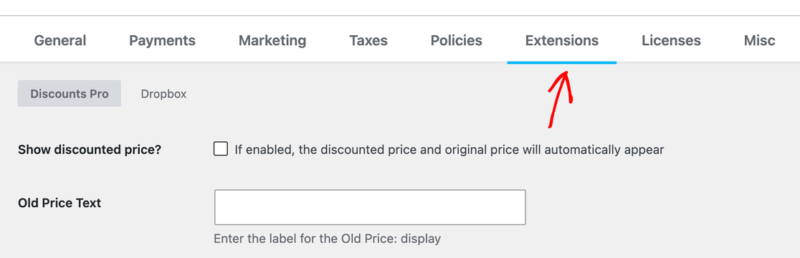
The Extensions tab only appears once at least one extension has registered settings. On a store with none, you won’t see the tab at all.
Since version 3.7, EDD registers its own hooks through event subscriber classes, and your extension can do the same. Your settings class subscribes to 2 filters:
edd_settings_sections_extensions: adds your section link to the Extensions tab. Add an entry to the array, using a unique key and the label store owners will see.edd_settings_extensions: adds your settings to the tab. Return your settings nested under the same key you used for the section, so EDD places them in your section.
3rd-party extensions should place your EDD specific settings under Downloads → Settings → Extensions → Your Extension Name. To see an example of how to register your subsection and settings, you can reference this Gist:
EDD saves these settings with the rest of its options. To read a value in your code, use edd_get_option( 'myext_enable_feature' ).
Each setting takes an id, a name, and a type. Common types include checkbox_toggle, text, textarea, select, rich_editor, and header. You can also set a default value with std.
To copy both files, see the example Gist on GitHub.
That’s it! You now know how to name, brand, and set up your extension so it fits right in with Easy Digital Downloads. To learn more about building on EDD, see the Developer’s Intro to Easy Digital Downloads.
FAQ on EDD Extension Development
Below, we’ve answered some of the most common questions about building 3rd-party extensions for EDD.
Do I need a pass to build an extension?
No. The settings tab and hooks in this guide are part of the free Easy Digital Downloads plugin.
Why don’t I see an Extensions tab in my settings?
The tab only appears once an extension registers at least one setting. After your code adds a section and its settings, the Extensions tab shows up under Downloads » Settings.
Will the EDD team support my extension?
No. Third-party extensions are supported by the developers who build them. Your customers need a clear way to reach you for help.
Can I start my extension’s name with Easy Digital Downloads?
Please don’t. Names that start with “Easy Digital Downloads” are reserved for our official extensions. WordPress.org also doesn’t allow a plugin slug to begin with another product’s name. Instead, use the “Extension Name for Easy Digital Downloads” format.