

A subscriber’s renewal date is coming up, and you’re not sure they’ll stay. A recurring renewal discount is one of the few levers you can pull in that moment.
Creating one in WordPress takes about two minutes. That’s the easy part.
The harder part is deciding whether a renewal discount is the right move at all, and then getting the code in front of the customer before they decide to leave. Most guides stop at the settings screen.
This one keeps going. You’ll learn how to create recurring renewal discounts in WordPress, how to choose between discounting the first payment and every renewal, and how to deliver the code automatically with a renewal reminder.
- Key Takeaways
- What Is a Recurring Renewal Discount?
- Should You Offer a Renewal Discount?
- First Order Only vs. First Order and Renewals
- How to Create a Recurring Renewal Discount in WordPress
- How to Get the Discount in Front of Subscribers
- Renewal Discount Examples Worth Copying
- Why Your Renewal Discount Isn't Applying
- FAQs About Recurring Renewal Discounts
Key Takeaways
| Three renewal options | Each discount can apply to the first order only, to first order and renewals, or follow your store default. |
| Discounts compound | A discount set to all renewals follows that subscriber for the life of the subscription, not just once. |
| Sticky products need less | If customers renew anyway, discount the first payment instead and keep your renewal revenue intact. |
| Delivery is the real work | A code nobody sees does nothing. Pair it with a renewal reminder email and a renewal link. |
| Two reminder systems | Recurring Payments reminders take over while a subscription is active. Software Licensing handles expired ones. |
What Is a Recurring Renewal Discount?
A recurring renewal discount is a coupon that lowers the price a subscriber pays when their subscription renews, instead of only on their first payment. You set it as a percentage or a flat amount, then choose whether it applies to the first order, to every renewal, or to both.
That last choice is the one that matters most, and it’s easy to get wrong.
A discount on the first payment is an acquisition tool. It lowers the cost of trying you out, then the price returns to normal at renewal.
A discount on every renewal is a retention tool. It follows the subscriber for as long as they stay, which means you’re trading margin on every future payment.
Both are useful. They solve different problems, and the setting you pick decides which one you built.
Should You Offer a Renewal Discount?
Not always. This is the question most tutorials skip, and getting it wrong costs more than a misconfigured coupon.
Renewal discounts work when price is the actual objection. When it isn’t, you’ve cut your revenue without changing anyone’s mind.
Non-renewal is a real and measurable cost. Stripe reports that private software companies see a median non-renewal rate of 10%, alongside losing a median 13% of customers each year.
But there’s a catch worth knowing before you discount anything. A discount changes who signs up, not just what they pay.
Customers who arrive because the price was low tend to leave when it isn’t. Price-led sign-ups become price-led cancellations, which means a discount can lower your churn this month and raise it next year.
When a renewal discount makes sense
Reach for one when your product is easy to replace or when it serves a short-term need. A one-off template pack or a theme someone used for a single project both fit.
There’s no accumulated value keeping that customer in place, so price is doing most of the work.
Win-back is the strongest case of all. A discount aimed at someone whose license already expired isn’t costing you revenue you were going to collect anyway.
When to discount the first payment instead
If your product gets more valuable the longer someone uses it, a renewal discount is usually money left on the table.
Think about a plugin holding a client’s live site together, or a course library someone has built a habit around. Those customers renew because leaving is expensive for them. Discounting their renewal changes nothing except your margin.
Use a first-order discount there. Lower the barrier to starting, then let the product earn the full renewal.
First Order Only vs. First Order and Renewals
Easy Digital Downloads (EDD) gives every discount code three renewal settings. Picking the right one takes ten seconds once you know what each does.
| Setting | Applies to | Best for |
|---|---|---|
| First Order Only | The initial payment. Renewals bill at full price. | Acquisition offers, trials, and sticky products where customers renew anyway. |
| First Order and Renewals | Every payment for the life of the subscription. | Loyalty pricing, win-back offers, and replaceable products where price drives the decision. |
| Store Default | Whatever you’ve set store-wide. The label shows the current default in parentheses. | Keeping codes consistent without setting each one by hand. |
One thing to watch: a discount set to all renewals doesn’t expire when the promotion does. That subscriber keeps the lower rate until they cancel. Run the math on a few years, not one payment.
How to Create a Recurring Renewal Discount in WordPress
Easy Digital Downloads handles renewal discounts through the Recurring Payments feature, and the whole process lives on one screen.
Before you start: You’ll need EDD with Recurring Payments active, which requires a Personal Pass or higher, plus at least one product set up as a recurring subscription. Already selling subscriptions? Skip straight to Step 1. If you’re not there yet, our guides on selling subscriptions with WordPress and the EDD getting started documentation will get you set up.
Step 1: Create the Discount Code
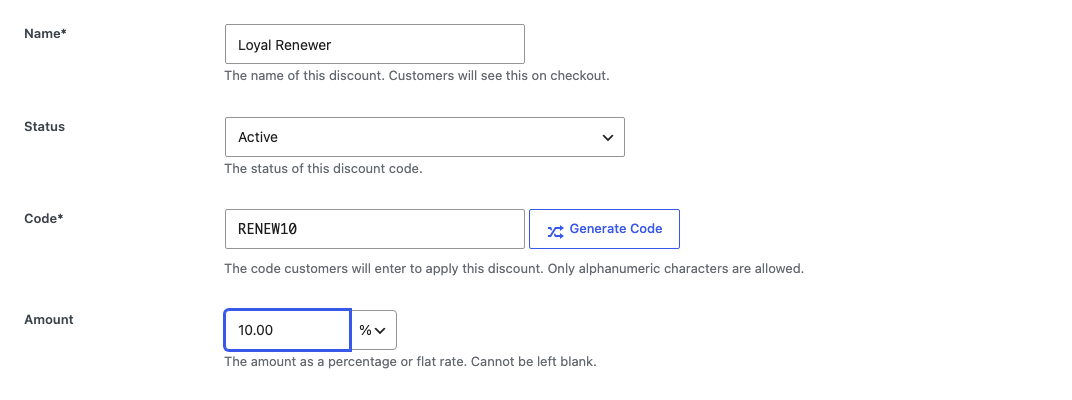
In your WordPress dashboard, go to Downloads » Discounts and click Add Discount.
Give the discount a Name your customers will recognize at checkout, since this is the label they see. Then add a Code, or click Generate Code to have EDD build one for you.
Set the Amount, and use the Amount Type selector beside it to choose a percentage or a flat rate.
Below that sit the fields that decide who can actually use the code. Download Requirements limits it to specific products, Downloads Excluded blocks it from others, and Categories does the same by product category.
Minimum Amount sets a cart subtotal floor. Max Uses caps how many times the code works in total. Status controls whether it’s Active, Inactive, or Archived.
For a renewal discount aimed at one subscription product, set Download Requirements to that product and leave the rest alone.
Step 2: Choose How the Discount Applies to Renewals
Scroll to Discount Renewal Orders. This is the setting that turns an ordinary coupon into a renewal discount.

You get three choices:
- Store Default, which shows your current store-wide setting in parentheses so you always know what you’re inheriting
- First Order Only, which discounts the initial payment and lets renewals bill at full price
- First Order and Renewals, which discounts every payment for as long as the subscription runs
Pick First Order and Renewals for a true recurring renewal discount.
One important limit: this setting applies to new subscriptions and orders only. Existing subscribers keep whatever pricing they signed up with, so a new code won’t retroactively change anyone’s active plan.
Check Use Once Per Customer if you want to stop the same person redeeming it repeatedly. Then click Create Discount.
Step 3: Set Your Store-Wide Default
If most of your codes should behave the same way, set the default once instead of choosing it every time.
Go to Downloads » Settings » Payments » Subscriptions and find One Time Discounts.

Leave this toggle off and your store default is first order and renewals, so codes apply to every payment unless you say otherwise. Switch it on and discounts apply only to the initial subscription payment.
Worth noting before you rely on it: one-time discount codes don’t apply to free trials. If your funnel runs through a trial, test the behavior you expect before promoting a code.
How to Get the Discount in Front of Subscribers
A discount code sitting in your dashboard does nothing. The subscriber has to see it before their renewal date, which means pairing the code with an automated email.
This is the step most renewal discount guides leave out entirely.
Send a subscription renewal reminder
Go to Downloads » Emails, click Add Email, and choose Add Subscription Reminder.

Set Reminder Type to Renewal, which sends only to active subscriptions. Then use Schedule Send to pick your timing, anywhere from the day of renewal to three months before it.
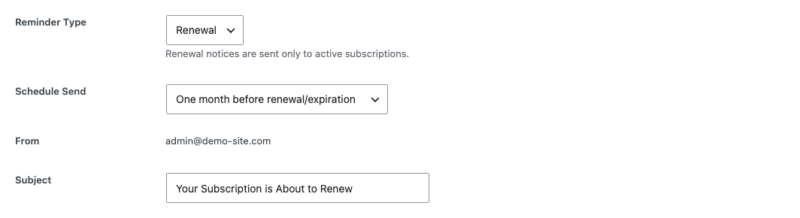
Write your discount code directly into the message body, then add the {renewal_link} tag so the customer can act on it without hunting for their account. Click Insert Tag to browse the full list, including {subscription_name}, {expiration}, and {amount}.
New reminders arrive disabled. Toggle the notice on and save, or it won’t send.
Reach expired and canceled customers
Win-back is where a renewal discount earns the most, and it runs through Software Licensing rather than Recurring Payments.
Under the same Add Email button, choose Add License Renewal Notice. Use When to Send Email to schedule it after expiration, then build the message around {license_key}, {expiration}, and {renewal_link}.
Software Licensing requires a Professional Pass or higher. For the full walkthrough on building out a reminder sequence, see our guide on automating software license renewal reminders.
The two reminder systems don’t stack. While a customer’s subscription is still active, Recurring Payments Subscription Reminder Notices are used and Software Licensing renewal reminders won’t fire. Once that subscription is canceled or expired, the Software Licensing notices take over. Build your win-back offer into the license notice, not the subscription reminder. The Recurring Payments and Software Licensing integration documentation covers how the two features hand off.
Renewal Discount Examples Worth Copying
Concrete setups beat theory. Each of these is a combination of the settings above.
First renewal nudge. A subscriber finishes a trial and faces their first real payment. Create a code at 20%, set Discount Renewal Orders to First Order and Renewals, cap it with Max Uses, and send it two weeks out.
Loyalty rate. Reward subscribers who’ve stayed. Build a code at 10% set to all renewals, restrict it with Download Requirements, and send it manually to long-term customers rather than publishing it.
Tiered schedule. Offer a smaller discount early and grow it over time, so the reward tracks tenure. Create separate codes for each tier and time each reminder to the renewal it targets.
Expired license win-back. A license lapsed three weeks ago. A License Renewal Notice scheduled one month after expiration, carrying a flat-rate code and {renewal_link}, targets revenue you’d otherwise write off.
Anniversary thank-you. A one-time code set to First Order Only on a subscriber’s yearly mark costs you a single payment instead of every future one.
Why Your Renewal Discount Isn’t Applying
Renewal discounts fail quietly. Run through these before assuming something is broken.
The subscription already existed. The Discount Renewal Orders setting affects new subscriptions and orders only. Active subscribers keep their original pricing.
A free trial is in the path. One-time discount codes don’t apply to free trials.
The store default is overriding your intent. If a code is set to Store Default, it follows the One Time Discounts toggle. Check the parenthetical on the dropdown to see what you’re actually inheriting.
Product restrictions are too tight. Download Requirements, Downloads Excluded, and Categories all silently block a code from products outside their scope.
The customer already used it. Use Once Per Customer blocks a second redemption.
Dates or limits ran out. Check the expiration date, Max Uses, Minimum Amount, and whether Status is still Active.
FAQs About Recurring Renewal Discounts
Can I apply a renewal discount automatically without a code?
Not through the discount system, which requires a customer to enter a code. The closest approach is setting your store-wide behavior under Downloads » Settings » Payments » Subscriptions, then distributing a code through an automated renewal reminder so the customer receives it without asking.
How do I give a discount only on the first renewal?
Create the discount code, set Discount Renewal Orders to First Order and Renewals, and add Max Uses or Use Once Per Customer to stop it repeating. Then time a subscription reminder to land before that first renewal so only those customers see it.
Do renewal discounts work with free trials?
One-time discount codes don’t apply to free trials in Easy Digital Downloads. If your subscriptions start with a trial, test the exact code and product combination you plan to promote before sending it to customers.
Will a new discount change existing subscriptions?
No. The Discount Renewal Orders setting applies to new subscriptions and orders only, so current subscribers keep the pricing they signed up with. To change an active subscription, edit that subscription directly under Downloads » Subscriptions.
Can I limit a renewal discount to specific products?
Yes. Use Download Requirements to restrict the code to chosen products, Downloads Excluded to block it from others, and Categories to scope it by product category. Leaving all three blank lets the code apply to everything.
Should a renewal discount last forever?
Rarely. A code set to First Order and Renewals stays with that subscriber until they cancel, so the cost compounds across every future payment. For sticky products where customers renew anyway, a first-order discount protects your renewal revenue and usually performs just as well.
Why isn’t my renewal discount showing at checkout?
Check that Status is Active, that the expiration date hasn’t passed, and that Max Uses and Minimum Amount haven’t blocked it. Then confirm the product isn’t excluded by Download Requirements, Downloads Excluded, or Categories, and that the customer hasn’t already redeemed a code limited by Use Once Per Customer.
Keep More Subscribers With the Right Renewal Discount
A recurring renewal discount is a precise tool, not a default setting. Used on replaceable products and lapsed customers, it recovers revenue you were about to lose. Used on customers who would have renewed anyway, it just costs you margin.
Configure it correctly, then make sure the customers who need it actually receive it before their renewal date. That second half is what separates a discount that works from one nobody redeems.
Ready to build yours? Learn about EDD Subscriptions and Billing or get started with your Pro Pass.
📣 P.S. Be sure to subscribe to our newsletter and follow us on Facebook, Twitter/X, or LinkedIn for more WordPress resources!