

When you sell a physical product, customers can touch it, hold it, and try it out before buying. When you sell a digital product, your description does all of that work.
A digital product description is the copy on your product page that explains what a buyer gets, why it’s worth buying, and how it will change things for them. It’s the difference between a browser clicking “buy” and clicking away.
According to Salsify’s 2026 Consumer Research report, 34% of shoppers will abandon a purchase because of an incomplete or poorly written product description. That’s a lot of lost sales from a fixable problem.
This guide walks you through exactly how to write digital product descriptions that convert. You’ll get real-world examples, a fill-in template, and tips to get found in both search and AI discovery tools.
Key Takeaways
- Lead with benefits. Buyers want to know what changes for them, not just what the product contains.
- Be specific. Vague claims lose sales. Precise details build trust.
- Match depth to price. A $9 template needs 75 words. A $299 course needs 300.
- Write for two audiences. Your description needs to persuade a human buyer and be readable by AI search engines.
- Use the right format. Narrative, bullet list, or hybrid: the best choice depends on your product type.
- What Is a Digital Product Description?
- What Every Great Digital Product Description Needs
- How to Write a Digital Product Description That Sells
- Types of Digital Product Descriptions
- Digital Product Description Examples
- How to Optimize Descriptions for Search and AI Discovery
- Digital Product Description Template
- FAQs About Digital Product Descriptions
- Start Selling with Better Product Descriptions
What Is a Digital Product Description?
A digital product description is marketing copy that explains what a digital product is, who it’s for, and what the buyer receives after purchasing. Unlike physical products, digital goods can’t be touched or tested before buying. The description carries the full weight of the sale.
A great digital product description does two things well: it tells the buyer exactly what they’re getting, and it convinces them it’s worth the price.
Digital product descriptions now serve a second audience, too. AI search tools like ChatGPT, Perplexity, and Google’s AI Overview increasingly guide purchase decisions by reading your product pages. If your description is vague or incomplete, AI engines skip your product and recommend a competitor’s instead.
🔎 For a bigger picture of how product descriptions fit into your overall store, see The Anatomy of a Digital Product Website.
What Every Great Digital Product Description Needs
Before writing a single word, it helps to know the components. High-converting digital product descriptions share the same core elements.
| Element | What It Does |
|---|---|
| Opening hook | Grabs attention and states the core benefit immediately |
| Benefits statement | Explains how the product improves the buyer’s life or work |
| Key features and specs | Confirms what’s included: file formats, quantity, compatibility |
| Social proof signal | A review snippet, rating, or “bestseller” label that builds confidence |
| CTA or urgency nudge | Prompts action (“Download instantly,” “Get lifetime access”) |
Not every description needs all five. A $9 template doesn’t need a lengthy benefits section. But the more convincing a buyer needs, the more of these elements belong on the page.
How to Write a Digital Product Description That Sells
The descriptions that consistently convert share the same core principles. Here’s what each one looks like in practice.
1. Lead with Benefits, Not Features
Features describe what a product is. Benefits describe what it does for the buyer.
“100 Lightroom presets” is a feature. “Get polished, consistent edits across your entire photo library in minutes” is a benefit.
Include the feature. Just don’t lead with it. Buyers are imagining what their life or work looks like after the purchase, not checking a spec sheet.
A simple translation formula: [Feature] + “so you can” + [Benefit].
2. Speak Your Customer’s Language
The vocabulary and tone of your description should match your buyer, not your product.
A plugin for WordPress developers can use technical shorthand. A meditation audio pack for beginners should avoid it. A dark and moody alt-pop sample pack can lean into words like “gritty,” “cinematic,” and “raw.” That’s how music producers talk.
When a description feels written for the right person, it converts. When it feels generic, it doesn’t.
3. Use Specific, Sensory Language
“High quality” means nothing. “Recorded through an AKG C414 microphone and processed through a UA SSL E channel strip” means something.
Specificity isn’t just for technical products. Even soft goods like eBooks and courses benefit from it. Instead of “comprehensive guide,” try “43-page step-by-step workbook with fill-in templates and a launch checklist.”
Concrete details signal that the product is real and the seller knows what they’re talking about.
4. Be Transparent About What’s Included
Digital product buyers can’t open the box before purchasing. They need to know exactly what they’re getting.
List file formats (PDF, MP3, PNG, SVG), quantities, access method (instant download, account login), and any compatibility requirements. This kind of clarity reduces refund requests and builds trust with buyers who are on the fence.
If there are limitations, say so. Honesty about what a product can’t do is more reassuring than silence.
5. Anticipate Your Buyer’s Reservations
Every buyer has an objection they haven’t voiced. “Is this too advanced for me?” “Will this work with my setup?” “What if I don’t get results?”
The best product descriptions name the fear and dissolve it before the buyer closes the tab.
- You can do this directly: “No experience required. Every step is explained from scratch.”
- Or through social proof: “Over 2,000 students have completed this course starting from zero.”
6. Match Depth to Price Point
Not every product needs a 300-word description. Match the length to how much convincing the buyer needs.
| Price range | Recommended length | What to emphasize |
|---|---|---|
| Under $25 | 50-100 words | Core benefit, what’s included, instant access |
| $25-$100 | 100-200 words | Benefits, specs, a trust signal |
| $100+ | 200-300+ words | Full benefits, social proof, objection handling |
Impulse purchases need punchy, fast copy. High-ticket products need more narrative.
Types of Digital Product Descriptions
The format of your description matters as much as the words. There are three main approaches.
Narrative Paragraph
A flowing, story-style description that builds emotional connection. Best for courses, memberships, and higher-ticket products where you need to earn trust before a buyer commits.
Use this when the buyer needs to feel something before they’ll spend.
Bullet List
A scannable, spec-forward format. Best for templates, file packs, plugins, and tools where buyers want to quickly confirm what’s included and whether it fits their needs.
Use this when the buyer just needs the facts fast.
Hybrid (Paragraph + Bullets)
Opens with a short narrative hook: one or two sentences that state the core benefit and connect emotionally. Then transitions into a bulleted list of specifics.
This is the most versatile format and works across almost every digital product type. Easy Digital Downloads’ product editor supports all three formats with full text formatting in the description field.
💡 For a broader look at optimizing your whole product page, see How to Optimize eCommerce Product Pages for Digital Downloads.
Digital Product Description Examples
Principles are easier to apply with real examples. Here are two that get it right, plus a before/after rewrite to show how much the approach matters.
Example 1: 91Vocals Audio Sample Pack
91Vocals sells audio sample packs to music producers. Their description for their alt-pop pack does something most sellers don’t: it speaks exactly like its buyer.
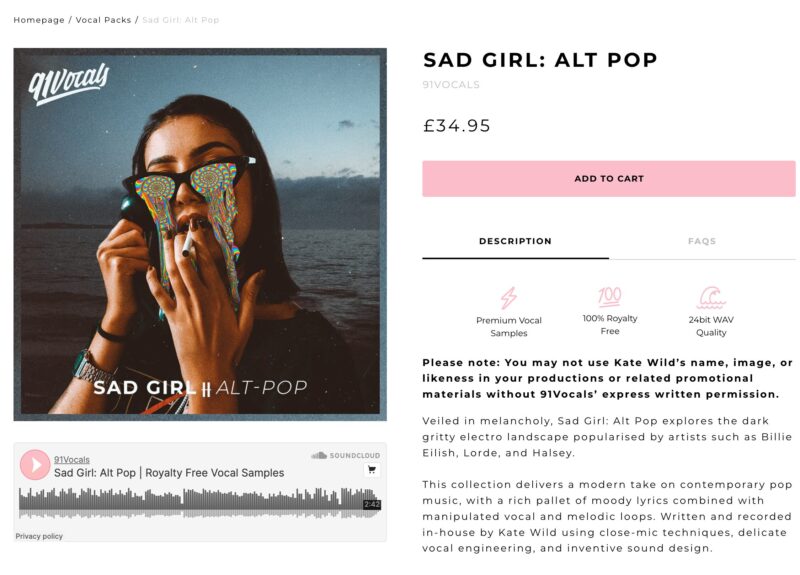
The language is evocative. Words like “dark,” “gritty,” “grungy,” and “moody” aren’t filler. They’re the exact aesthetic terms a trend-focused producer uses when searching for sounds. The description then backs up the mood with hard specs: microphone model, signal chain, and file types.
🔑 Key lessons: Know your audience well enough to use their vocabulary. Then back up the mood with technical specifics.
Example 2: BassBuzz Online Course
BassBuzz sells a beginner bass guitar course. Their description is a clear example of objection handling done right.
They lead with the real outcome: playing songs and performing with others. They acknowledge that reaching a proficient level “takes years” rather than making unrealistic promises. They address fears directly: “No confusion, no head scratching.” “You won’t feel overwhelmed.”
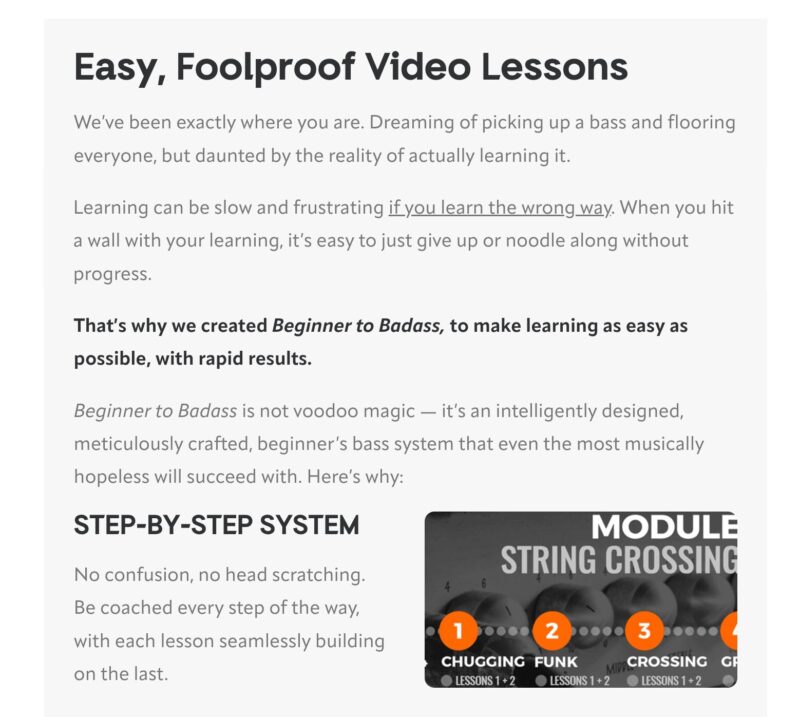
The line “We’ve been exactly where you are” is the most important sentence on the page. It signals empathy, and empathy converts.
🔑 Key lessons: Lead with the life after the purchase. Be honest about limitations. Name the fear before the buyer does.
Example 3: Before and After (Notion Productivity Template)
Here’s what a weak product description looks like, and what happens when you apply these principles.
Before:
This Notion template will help you get organized. It includes multiple pages for tracking tasks, goals, and projects. Great for anyone who wants to be more productive.
After:
Stop losing track of what matters. This Notion productivity template gives you a complete system for managing tasks, goals, and weekly reviews in one workspace.
What’s included:
- Weekly planner with daily focus blocks
- Goal tracker with milestone check-ins
- Project dashboard with status views
- 30-minute setup guide (PDF)
Compatible with Notion free and paid plans. Instant download. Your system is ready today.
The “after” version leads with a pain point, states the benefit, lists exactly what’s included, handles a compatibility question, and closes with urgency. Same product. Very different result.
How to Optimize Descriptions for Search and AI Discovery
Writing a compelling description is step one. Getting it found is step two.
SEO Basics for Product Descriptions
Include your primary keyword in the first 50 words of your description. Use natural variations throughout. Don’t repeat the same phrase back to back.
Write for the buyer first. Keyword stuffing reads poorly and can hurt your rankings. One or two natural uses of your main keyword in a 200-300 word description is the right amount.
Your product page title, description, and URL should all reinforce the same keyword signal.
For a full guide on product page SEO, see Beginner’s Guide to eCommerce SEO.
Writing for AI Search
AI search tools increasingly guide what products buyers discover. They don’t browse your store. They parse your product descriptions looking for specific, structured information.
If your description says “high quality audio files,” an AI engine has nothing concrete to cite. If it says “24 WAV stems, 44.1kHz, royalty-free for commercial use,” that’s something an AI can recommend with confidence.
A few principles for AI-ready descriptions:
- State formats, quantities, and compatibility explicitly
- Use plain declarative sentences (“This template works with Notion free and paid plans”)
- Avoid hedge language (“may work with,” “could be useful for”)
- Answer the questions buyers ask AI assistants directly in your copy
💡 For a deeper look at how AI search affects your digital product store, see our AI search optimization guide.
Digital Product Description Template
Use this as a starting point for any digital product. Fill in the brackets, then adjust the tone to match your audience.
[Product Name] is a [product type] for [target audience] who want to [desired outcome].

[1-2 sentences on the core benefit: what changes for the buyer after using this product.]

What's included:
- [Key item or file 1]
- [Key item or file 2]
- [Key item or file 3]

[1 sentence addressing a common reservation: compatibility, skill level, or usage rights.]

[File format / access method / compatibility details.]
For narrative descriptions: Write each element as a flowing sentence rather than a list. Lead with the outcome, then move into the specifics.
For high-ticket products: Expand the benefits section to 3-5 sentences and add a social proof line (“Over X customers have used this to…”).
FAQs About Digital Product Descriptions
What should a digital product description include?
A strong digital product description includes an opening benefit statement, a list of what’s included (file types, quantities, access method), compatibility or requirement details, and a call to action. For mid-to-high-ticket products, add social proof and address common buyer hesitations.
How long should a digital product description be?
It depends on price point. Products under $25 typically need 50-100 words. Mid-range products ($25-$100) do well at 100-200 words. Products over $100 often need 200-300 words or more to build enough confidence for the buyer to commit.
What is the difference between features and benefits in a product description?
A feature is what a product has or does. A benefit is what that means for the buyer. “50 editable slides” is a feature. “Build a professional pitch deck in an afternoon without starting from scratch” is a benefit. Descriptions that lead with benefits consistently outperform ones that list features first.
How do I make my product description rank in search results?
Include your primary keyword naturally in the first 50 words, use variations throughout, and write in plain readable language. Make sure your product page title and URL reinforce the same keyword. Adding Product schema markup helps search engines display rich results for your listing.
How do product descriptions affect AI search recommendations?
AI search tools scan product descriptions for specific, structured information. Descriptions with explicit details, including file formats, compatibility, quantities, and use cases, are more likely to be cited than vague marketing copy. Write as if you’re answering a direct question: what exactly does the buyer get?
Can I use AI tools to help write product descriptions?
Yes. AI tools can speed up the drafting process. The key is treating the output as a first draft. Review for accuracy, add your specific product details, adjust the tone to match your brand, and make sure all specs and inclusions are correct. Generic AI copy tends to be vague, which is the opposite of what converts.
Start Selling with Better Product Descriptions
A great digital product description doesn’t have to be long. It just has to be specific, honest, and written for the right person.
Lead with what changes for your buyer. Be clear about exactly what they’re getting. Handle their hesitation before they close the tab.
If you’re selling on Easy Digital Downloads, you can apply everything in this guide directly in your product editor. Pair strong descriptions with professional product images and you’ve got a product page that works.
Not on Easy Digital Downloads yet? Start your digital download store in WordPress and put these principles to work today.
📣 P.S. Be sure to subscribe to our newsletter and follow us on Facebook, Twitter/X, or LinkedIn for more WordPress resources!