

“Generative engine optimization” has turned into one of those terms everyone throws around but nobody quite explains. You’ve probably seen it mentioned alongside AI Overviews, ChatGPT’s shopping results, or Perplexity’s answer boxes, usually followed by a vague promise that it will boost your visibility with AI tools.
Here’s the problem: most GEO explainers are written for content marketers in general, not for people running an ecommerce store. And most of the ecommerce-specific advice skips past what GEO actually is and jumps straight into a tactics list.
This guide fills that gap. You’ll learn what generative engine optimization actually means, why it’s different from SEO, and where digital sellers specifically need to think differently than a store shipping physical inventory. Once you understand the what and why, I’ll point you to the exact steps for putting it into practice.
- Key Takeaways
- What Is Generative Engine Optimization (GEO)?
- GEO, AEO, AIO, LLMO: Untangling the Acronym Soup
- Why GEO Matters for Ecommerce as a Category
- Why Digital Product Sellers Need a Different Playbook Than Physical Retailers
- The Core Levers of GEO, at a Glance
- Is GEO Worth It If You're a Solo Creator or Small Team?
- FAQs About GEO for eCommerce
- Start Small, and Let AI Search Work for You
Key Takeaways
- GEO isn’t SEO 2.0. AI search reads, chunks, and cites your content inside a generated answer instead of ranking it as a link on a results page.
- The acronyms overlap. GEO, AEO, AIO, and LLMO all describe roughly the same shift, just from slightly different angles.
- Digital products play differently. Most GEO advice assumes shipping and inventory, which doesn’t apply if you’re selling downloads, software, or courses.
- Small stores aren’t excluded. You don’t need enterprise-level tooling to start.
What Is Generative Engine Optimization (GEO)?
Generative engine optimization is the practice of structuring your content so AI tools like ChatGPT, Google AI Overviews, and Perplexity can understand it, trust it, and use it to answer a shopper’s question directly.
That’s a meaningfully different job than traditional search engine optimization (SEO). With SEO, your goal is to rank high enough on a results page that someone clicks on your site. With GEO, your content might never get clicked at all. Instead, an AI tool reads your product page, pulls out the relevant details, and hands the answer straight to the shopper, sometimes with a link back to you and sometimes without one.
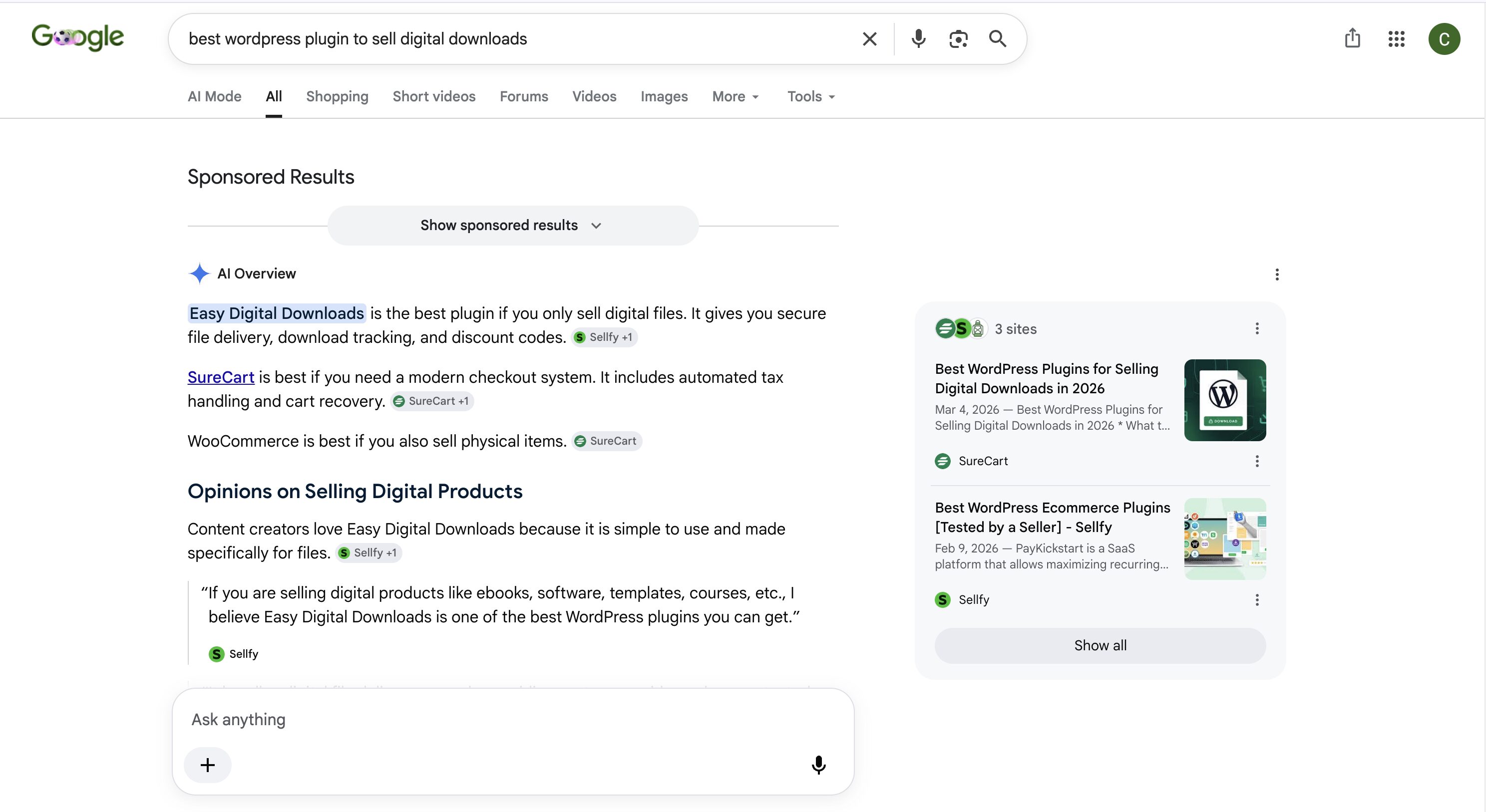
That’s why GEO earned its own name instead of just becoming “modern SEO.” The mechanics are genuinely different.
AI systems don’t scan for keyword density. They break your content into smaller pieces, or chunks, and evaluate each one for how clearly it answers a specific question. A page that’s technically well-optimized for Google can still get skipped by an AI answer if the actual sentences are vague or buried in marketing language.
For ecommerce specifically, this shows up most in product discovery. Someone asking ChatGPT “what’s a good tool for X” is having the exact conversation your product page used to have with them directly. If your content isn’t structured for an AI system to parse, you’re not in that conversation at all.
GEO, AEO, AIO, LLMO: Untangling the Acronym Soup
If you’ve felt lost trying to keep track of GEO, AEO, AIO, and LLMO, you’re not alone. Most of the content written about this topic uses them almost interchangeably, which doesn’t help.
Here’s the practical breakdown:
| Term | Full Name | Focus |
|---|---|---|
| GEO | Generative Engine Optimization | The broadest, most commonly used term. Optimizing for any AI system that generates an answer rather than a list of links. |
| AEO | Answer Engine Optimization | Getting your content selected as the direct answer to a question, whether that’s an AI Overview or a voice assistant. |
| AIO | AI Optimization | Often used as a shorthand for the same general idea as GEO, without a sharper distinction. |
| LLMO | Large Language Model Optimization | Optimizing specifically for how large language models like GPT or Gemini process and cite content. |
In practice, the differences matter less than the underlying idea: write and structure your content so a machine can confidently extract and repeat it. If you keep that goal in mind, you don’t need to memorize which acronym applies where.
Why GEO Matters for Ecommerce as a Category
You already know AI search exists. What’s less obvious is how directly it affects product discovery specifically, not just informational searches.
Shoppers are increasingly asking AI tools questions they used to type into Google: “what’s the best software for X,” “recommend a template for Y.” Adobe Analytics has tracked triple-digit growth in AI-driven referral traffic to retail sites over the past year, and that trend shows no signs of slowing down.
The shift matters more for product searches than you might expect. When someone asks an AI tool for a recommendation, it’s making a purchasing decision on the shopper’s behalf, at least partially. If your product isn’t structured clearly enough to be understood and trusted by that AI system, it simply won’t get mentioned, no matter how good the product actually is.
This isn’t a “someday” problem. It’s happening in real search sessions right now, which is exactly why GEO has become a strategic priority rather than an experimental one.
Why Digital Product Sellers Need a Different Playbook Than Physical Retailers
Here’s where almost every GEO guide falls short for EDD readers: they assume you’re shipping something.
Structured data recommendations (essentially, organized tags and labels that tell AI systems exactly what your product is) built around physical retail lean heavily on inventory counts, shipping costs, and SKU-level data feeds. If you sell downloads, software licenses, or online courses, none of that applies to you the same way. You don’t have a warehouse. You don’t have shipping windows. Your “inventory” is infinite the moment you hit publish.
That actually works in your favor in one important way: AI tools that understand your product is instantly deliverable can present it as a faster, lower-friction option than a comparable physical product. Instant access is a real selling point, and it’s worth stating plainly in your product descriptions rather than assuming an AI system will infer it.
But it also creates blind spots that generic advice won’t catch. Digital products often need details that don’t map to standard ecommerce schema, like file formats, version numbers, license terms, or compatibility requirements. If that information is missing or buried, an AI tool has nothing solid to cite, and it will move on to a competitor’s listing that spelled it out.
🪄 We’ve written a full walkthrough on exactly how to fix this for your Easy Digital Downloads store: How to Get Your Digital Products Found by AI Search. That post covers the hands-on implementation. The rest of this guide is about making sure you understand the “why” behind those steps.
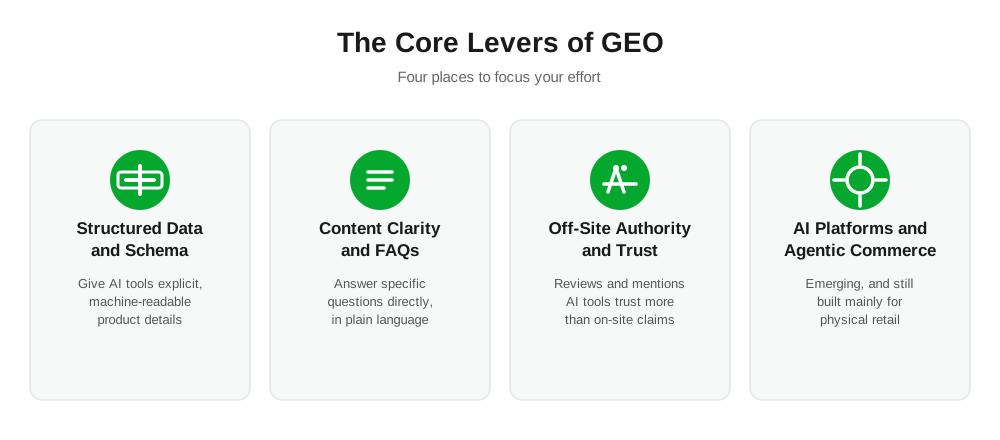
The Core Levers of GEO, at a Glance
You don’t need to master every AI platform’s ranking algorithm to make real progress. Most of what works comes down to a handful of levers.
Structured Data and Schema Markup
Schema markup gives AI tools explicit, machine-readable details about your product instead of forcing them to guess from prose. It’s consistently the highest-leverage GEO tactic across every source we reviewed while researching this piece. Our companion post walks through exactly which schema types matter for digital products and how to add them with the popular WordPress plugin AIOSEO, without touching code.
Content Clarity and FAQ Coverage
AI tools favor content that answers a specific question directly, in plain language, near the top of the section. Vague marketing copy gets skipped. FAQ sections are one of the easiest wins here, since they’re already structured as a question and a direct answer.
Off-Site Authority and Trust Signals
AI tools weigh third-party reviews and mentions more heavily than on-site testimonials, because they’re harder to manipulate. Getting reviewed on relevant platforms and earning mentions from other sites both feed into this.
Getting Into AI Platforms and Agentic Commerce
Some AI platforms let brands submit product feeds directly, similar to Google Merchant Center. Worth knowing honestly: most of this tooling still assumes a physical retail catalog, so its usefulness for digital-only sellers is currently limited. Structured data on your own site remains the more reliable lever for now.
Is GEO Worth It If You’re a Solo Creator or Small Team?
Yes, and this matters because most GEO content assumes you’re not. A lot of the advice out there is written for teams with dedicated data warehouses, business intelligence tooling, and enterprise-scale product catalogs. If you’re running your digital product store solo or with a small team, that framing doesn’t apply to you, and you can safely ignore it.
What actually matters at your scale is much simpler: clear product descriptions, basic schema markup, a handful of genuine reviews, and a website that AI crawlers can actually access. None of that requires a data team. It requires the same attention to detail you’d already want to put into a product page that converts human visitors.
Start with your best-selling or most-searched products rather than trying to overhaul your entire catalog at once. You’ll see where the effort pays off before deciding whether to expand it further.
FAQs About GEO for eCommerce
What is generative engine optimization (GEO)?
GEO is the practice of structuring your content so AI tools like ChatGPT and Google AI Overviews can understand, trust, and cite it when answering a shopper’s question, rather than just ranking it as a link.
What’s the difference between GEO, AEO, AIO, and LLMO?
They all describe the same general shift toward optimizing for AI-generated answers, with slightly different emphasis. GEO is the broadest term, AEO focuses on direct-answer content, and LLMO narrows in on large language models specifically. In practice, the underlying goal is the same across all four.
How is GEO different from traditional SEO?
SEO aims to rank your page high enough that someone clicks through. GEO aims to get your content understood and cited inside an AI-generated answer, which may not involve a click at all. The two overlap but aren’t the same goal.
Does GEO apply to digital products, not just physical ecommerce?
Yes, and arguably more so. Digital products don’t have shipping or inventory data to lean on, so clear product descriptions and schema markup matter even more. Our companion implementation guide covers the specifics.
Is GEO worth it for a small, one-person digital store?
Yes. Most of the enterprise-focused advice you’ll find doesn’t apply at your scale, but the core levers, clear descriptions, schema markup, and real reviews, work just as well for a solo creator as they do for a larger team.
How do I actually start implementing GEO for my store?
Start with the schema and content clarity levers on your best-selling products. Our companion guide, How to Get Your Digital Products Found by AI Search, walks through the exact steps.
Start Small, and Let AI Search Work for You
Generative engine optimization sounds like a bigger shift than it actually needs to be. You don’t need to reinvent your store or chase every acronym in this space. You need clear product descriptions, a few key pieces of structured data, and genuine reviews that AI tools can trust.
Ready to put this into practice? Head over to our step-by-step implementation guide for exactly what to do next, including how AIOSEO makes the schema markup piece straightforward.
📣 P.S. Be sure to subscribe to our newsletter and follow us on Facebook, Twitter/X, or LinkedIn for more WordPress resources!