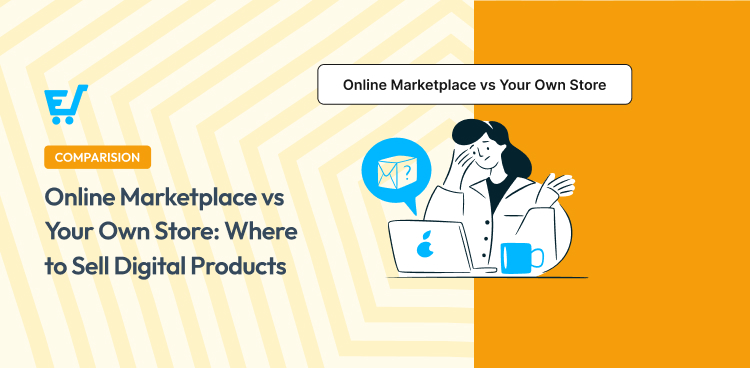


Choosing where to sell your digital products isn’t just a technical decision. It’s a business decision that affects how much you earn, how much control you have, and whether you’re building something you actually own.
Marketplaces like Etsy and Gumroad make it easy to get started. But easy to start isn’t the same as best for your business long-term.
This guide breaks down the three main ways to sell digital products, what each one actually costs in 2026, and how to decide which path makes the most sense for where you are right now.
- Key Takeaways
- The Three Ways to Sell Digital Products
- What Selling Platforms Actually Charge in 2026
- Selling on a Marketplace: Pros & Cons
- Selling on a Hosted Platform: Pros & Cons
- Selling From Your Own Store: Pros & Cons
- Which Option Is Right for You?
- Can You Do Both?
- How to Build Your Own Digital Store With EDD
- How to Drive Traffic to Your Own Store
- FAQs on Where to Sell Digital Products
- Where is the best place to sell digital products?
- What percentage does Gumroad take in 2026?
- What is the best platform to sell digital downloads?
- Should I sell digital products on Etsy or my own website?
- How much does it cost to sell on Etsy?
- Can I sell digital products for free with Easy Digital Downloads?
- What is the difference between a marketplace and a hosted platform?
- Start Selling on Your Own Terms
Key Takeaways
| Three options | You can sell through a marketplace, a hosted platform, or your own self-hosted store. |
| Marketplaces | Built-in traffic, but you pay commission on every sale and don’t own the customer relationship. |
| Hosted platforms | Your own storefront, but you’re still renting on someone else’s infrastructure and paying per-sale fees. |
| Self-hosted stores | Full ownership, no per-sale platform fees, and a brand that belongs entirely to you. |
| Best long-term option | A self-hosted store with WordPress and Easy Digital Downloads gives you the most control and the highest margins. |
The Three Ways to Sell Digital Products
Not all selling platforms work the same way. Before you can compare them fairly, it helps to understand the three categories.
Marketplaces
Marketplaces like Etsy and Creative Market host thousands of sellers under one roof. Buyers browse the platform itself, not your individual brand. You benefit from built-in traffic, but you compete directly with other sellers, follow the platform’s rules, and pay commission on every sale.
Hosted Platforms
Hosted platforms like Gumroad and Payhip sit in the middle. You get your own storefront and product pages, but the platform still hosts everything and takes a cut of your revenue. You have more control than a marketplace, but you’re still renting space on someone else’s platform.
Self-Hosted Stores
A self-hosted store runs on your own website. Tools like WordPress and Easy Digital Downloads (EDD) let you build a store you fully own. You control the design, the checkout, the customer data, and the pricing. There are no per-sale fees beyond standard payment processing costs, and no one can change the rules on you.
Each option involves real trade-offs. The right choice depends on where you are in your business and what you’re optimizing for.
What Selling Platforms Actually Charge in 2026
Platform fees are one of the most important factors in choosing where to sell. Here’s what the most popular options actually cost per sale.
| Platform | Type | Transaction Fee | Monthly Cost | Notes |
|---|---|---|---|---|
| Etsy | Marketplace | 6.5% + $0.20 listing fee | $0 | Payment processing adds ~3% + $0.25 per transaction |
| Creative Market | Marketplace | 40% commission | $0 | Sellers keep 60% of each sale |
| Gumroad | Hosted platform | 10% | $0 | Applies to every sale regardless of volume |
| Payhip | Hosted platform | 5% / 2% / 0% | $0 / $29 / $99 | Zero-fee plan requires $99/mo subscription |
| Sellfy | Hosted platform | 0% | $29 to $159 | Monthly subscription covers transaction fees |
| Easy Digital Downloads | Self-hosted | 0% | Hosting + optional features | Pay Stripe/PayPal processing only (~2.9% + $0.30) |
What this looks like in practice: If you earn $3,000 in a month, Gumroad takes $300. Etsy takes roughly $225 to $285 depending on your product prices. With EDD on your own site, you keep everything except payment processor fees, which run about $87 to $90 at that volume.
The platforms that advertise “free” plans still cost money on every sale. Self-hosting shifts the cost to a flat monthly expense for hosting, which typically runs $10 to $25 per month.
Selling on a Marketplace
Marketplaces like Etsy, Creative Market, and Amazon are platforms where multiple sellers compete for the same buyers. You list your products alongside thousands of others, and the platform drives the traffic.
The Advantages ✅
- Built-in audience. The biggest appeal of a marketplace is that buyers are already there. You don’t have to build an audience from scratch, which makes it a lower-risk way to test a product idea.
- Quick setup. Getting your first product live on Etsy or Creative Market takes hours, not days. There’s no hosting to configure, no theme to choose, and no checkout to set up.
- Lower barrier to entry. Because the platform handles the infrastructure, you can start selling with almost no upfront cost.
The Disadvantages 🧐
- Fees add up fast. Etsy charges a listing fee, a transaction fee, and a payment processing fee on every single sale. At scale, you’re giving away nearly 10 cents of every dollar you earn before factoring in any marketing spend.
- You don’t own the customer relationship. When someone buys from you on Etsy, they’re Etsy’s customer first. You can’t email them directly, retarget them with ads, or build the kind of direct relationship that drives repeat purchases.
- Your brand is secondary. Buyers see the marketplace brand, not yours. You’re competing with dozens of similar products on the same page, often on price alone.
- The rules can change. Platform policies shift, fee structures increase, and algorithms change without warning. Sellers who built their entire business on a marketplace have had their income disrupted overnight.
Selling on a Hosted Platform
Hosted platforms like Gumroad, Payhip, and Sellfy give you your own product pages and a storefront you can share directly. They sit between a marketplace and a self-hosted store.
The Advantages ✅
- More control than a marketplace. Your products aren’t competing for attention alongside other sellers. You have your own storefront URL and you can customize how your products are presented.
- Simple setup. Hosted platforms are designed to get you selling quickly. No WordPress installation, no plugin configuration, just a sign-up and a product listing.
- Built-in file delivery. Like marketplaces, hosted platforms handle secure file delivery automatically after each purchase.
The Disadvantages 🧐
- Per-sale fees are unavoidable on free plans. Gumroad charges 10% on every sale. Payhip’s free plan charges 5%. To reduce or eliminate those fees, you need to upgrade to a paid subscription, which can cost $29 to $99 per month.
- You still don’t own the platform. If Gumroad changes its fee structure again (it raised fees to 10% in 2023), you have no leverage and no alternative except to migrate. Your store, your products, and your customer history all live on someone else’s server.
- Limited customization. Hosted platforms offer templates and some branding options, but you’re working within the platform’s constraints. Deep customization, unique checkout experiences, and full brand control aren’t available.
Selling From Your Own Store
Building your own digital store on WordPress with Easy Digital Downloads gives you full ownership over every part of the experience.
The Advantages ✅
- No per-sale platform fees. EDD doesn’t charge a commission or transaction fee on top of your payment processor’s standard rates. What you earn, you keep.
- Full brand control. Your store looks exactly the way you want it to. Your checkout carries your name, your colors, and your content. Customers buy from you, not from a platform.
- You own the customer relationship. Every buyer who checks out on your site is your customer. You can build an email list, run targeted campaigns, and bring people back for repeat purchases.
- The platform can’t change the rules on you. Your WordPress site is yours. No policy update, no fee increase, and no algorithm change can affect your store without your permission.
- Flexible and scalable. EDD’s feature library covers subscriptions, software license keys, affiliate marketing, EU VAT compliance, and more. You add what you need as your business grows.
The Disadvantages 🧐
- You have to drive your own traffic. There’s no built-in audience. Getting buyers to your store requires consistent work on SEO, email marketing, and content.
- More initial setup. Getting your store live takes longer than listing a product on Gumroad. You’ll need hosting, a domain, WordPress, and EDD configured before your first sale.
- Ongoing maintenance. Your site is your responsibility. That means keeping plugins updated, monitoring security, and handling any technical issues that come up.
Which Option Is Right for You?
The right choice depends on where you are in your business and what you’re optimizing for.
If you’re just starting out and want to test a product idea with minimal setup, a marketplace or hosted platform gets you selling fast. The fees are the cost of that convenience. Just go in with clear eyes about what you’re paying.
If you’ve validated your product and you’re ready to scale, the math shifts quickly in favor of owning your store. At $3,000/month in sales, Gumroad costs you $300 in fees every month. At $10,000/month, that’s $1,000. A self-hosted store on EDD costs roughly $15/month in hosting.
If building a brand matters to you, a marketplace will always work against that goal. Your own store is the only place you can fully own the customer relationship and build an audience that’s yours to keep.
If you sell software or need subscriptions, a self-hosted store is almost certainly the right choice. EDD’s Software Licensing and Recurring Payments features handle license keys, renewals, and subscription management in a way no hosted platform can match.
Can You Do Both?
If you can’t decide where to sell digital products and are curious whether you can take a multi-channel approach, the answer is: Yes, and a lot of sellers do.
Starting on Etsy or Gumroad while building your own store is a practical approach. You generate early sales and gather feedback while your self-hosted store takes shape. Once your own store is established, you can gradually shift your traffic and marketing toward your own platform.
Some sellers keep a permanent dual presence: they use a marketplace for discoverability and their own store as the primary sales channel. Email marketing is the bridge between the two. If you can get a marketplace buyer onto your email list, you can bring them back to your own store for future purchases.
The key is treating the marketplace as a traffic source, not as your business. The business lives on the platform you own.
How to Build Your Own Digital Store With EDD
If you’re ready to launch your own store, Easy Digital Downloads is the most direct path for WordPress users.
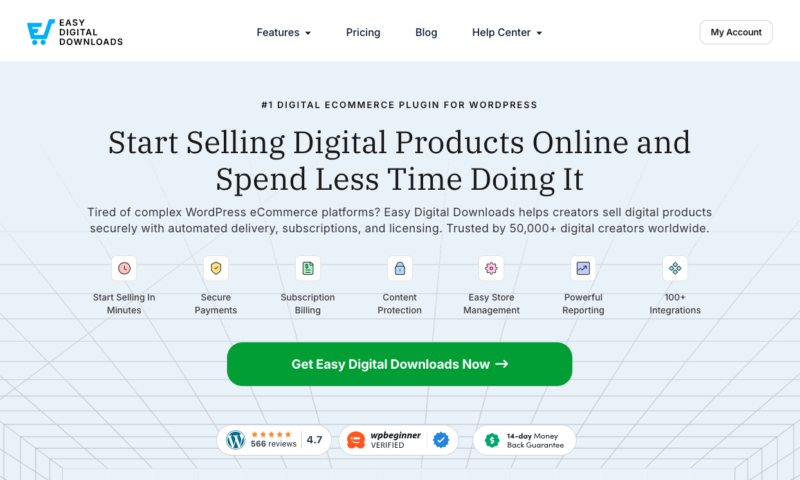
EDD is purpose-built for digital product sellers. It handles secure file delivery, customizable checkout, discount codes, and payment processing through Stripe and PayPal.
The free core plugin covers everything you need to start. Advanced features like Recurring Payments and Software Licensing are available through EDD’s paid pass tiers.
To get started, you’ll need:
- A domain name (your store’s web address)
- WordPress hosting (providers like SiteGround or Bluehost work well with EDD, starting around $10 to $15/month)
- The EDD plugin (free from WordPress.org)
- A payment gateway (Stripe or PayPal, both included in the free plan)
WordPress powers over 43% of all websites on the internet, and EDD is trusted by over 50,000 businesses. The combination gives you a proven, flexible foundation that scales with your business.
⚙️ For a step-by-step guide, check out how to create a digital download store in WordPress.
How to Drive Traffic to Your Own Store
Owning your store means driving your own traffic. Here’s how digital sellers do it effectively.
Search engine optimization. Every product page and blog post is an opportunity to rank in search results. Research the terms your buyers search for and use them naturally in your product titles and descriptions. Organic traffic is one of the most valuable long-term assets a digital seller can build.
Email marketing. Connect EDD to an email marketing service like Mailchimp or ConvertKit and automatically add customers to your list after every purchase. Your email list belongs to you. No algorithm change can cut you off from it.
Content marketing. Publishing blog posts, tutorials, or short-form video content related to your niche builds organic traffic and establishes credibility with your audience over time.
Affiliate marketing. AffiliateWP integrates directly with EDD and lets you recruit affiliates to promote your products for a commission you control. You only pay for results.
FAQs on Where to Sell Digital Products
Where is the best place to sell digital products?
The best place depends on your goals. If you want to start immediately with minimal setup, a marketplace like Etsy or a hosted platform like Payhip gets you selling fast. If you want to keep more of your revenue and build a real brand, selling from your own website with Easy Digital Downloads gives you full control and no per-sale platform fees.
What percentage does Gumroad take in 2026?
Gumroad charges a flat 10% fee on every sale. This applies regardless of your sales volume. On a $50 product, Gumroad keeps $5 before payment processing fees are added.
What is the best platform to sell digital downloads?
For sellers focused on long-term control and higher margins, a self-hosted store with WordPress and Easy Digital Downloads is the strongest option. For sellers who want a quick start with minimal setup, Payhip or Gumroad are common starting points, though the fees add up quickly at any meaningful sales volume.
Should I sell digital products on Etsy or my own website?
Etsy gives you access to its existing audience, which helps early on. But Etsy’s combined fees add up to roughly 9 to 10 cents on every dollar you earn. Your own website has no per-sale platform fees and lets you build a customer list you actually own. Many sellers start on Etsy and shift to their own store as their business grows.
How much does it cost to sell on Etsy?
Etsy charges $0.20 per listing, a 6.5% transaction fee on the sale price, and payment processing fees of roughly 3% plus $0.25 per transaction. On a $20 product, that’s about $2.20 in fees before Etsy Ads or offsite ad fees are factored in.
Can I sell digital products for free with Easy Digital Downloads?
Yes. The EDD core plugin is free and includes everything you need to sell digital files from your WordPress site. You’ll still need WordPress hosting (typically $10 to $25 per month) and a payment processor like Stripe or PayPal, which charge standard processing rates. Easy Digital Downloads does not add any platform or transaction fees on top of those costs.
What is the difference between a marketplace and a hosted platform?
A marketplace like Etsy or Creative Market puts your products in a shared catalog with other sellers. Shoppers browse the platform, not your brand. A hosted platform like Gumroad or Payhip gives you your own product pages and storefront URL, but the platform still controls the infrastructure and takes a percentage of your sales. A self-hosted store gives you full ownership of both.
Start Selling on Your Own Terms
Marketplaces and hosted platforms have their place, especially when you’re getting started. But every sale you make on someone else’s platform is a sale that builds their business as much as yours.
Your own store changes that. With WordPress and Easy Digital Downloads, you keep more of what you earn, own your customer relationships, and build a brand that belongs entirely to you.
Over 50,000 businesses already sell their digital products with Easy Digital Downloads. Install the free plugin and launch your store today.
If you want to hit the ground running, start immediately with a Pro pass.
Want to learn more? Check out the Best Marketplace Alternatives for Digital Products.
📣 P.S. Be sure to subscribe to our newsletter and follow us on Facebook, Twitter/X, or LinkedIn for more WordPress resources!