

WordPress limits how large a file you can upload. Most hosting plans set that cap somewhere between 32MB and 256MB, depending on your server configuration.
That’s fine for PDFs and small audio files. It’s not fine for video courses, large software bundles, or high-resolution photo collections.
The solution is cloud storage. Easy Digital Downloads (EDD) integrates directly with Amazon S3 and Dropbox, letting you store large files off your server and deliver them to customers without any size limit.
This guide walks you through the whole setup: how to choose between Amazon S3 and Dropbox, how to connect your account, how to configure EDD for large-file delivery, and how to create your first product.
- Key Takeaways
- Why WordPress Struggles With Large Files
- Step 1: Get Easy Digital Downloads
- Step 2: Choose Your Cloud Storage
- Step 3: Connect Your Storage Account
- Step 4: Set Your Download Method
- Step 5: Upload Your File and Create Your Product
- FAQs on Selling Large Files in WordPress
- Start Selling Large Files on Your WordPress Site
Key Takeaways 💡
| The Problem | WordPress limits file upload sizes, and large files strain your server on every download. |
| The Solution | Store files in Amazon S3 or Dropbox; EDD delivers them to customers directly from the cloud. |
| What You Need | An Easy Digital Downloads Extended Pass or higher. Cloud storage features are not included in the free version. |
| Download Setting | Use the Redirect delivery method for large files. It keeps your server completely out of the loop. |
Why WordPress Struggles With Large Files
Your WordPress host sets a maximum file upload size. Most plans land somewhere between 32MB and 256MB. Some hosts allow more, but the cap is always there.
Even if you raise that limit, routing a 2 GB video course or a 500 MB software package through your server on every download is a bad idea. PHP has to proxy the entire file, which hits execution time limits for large files and can cut the download off mid-transfer.
Cloud storage removes your server from the equation. When a customer clicks to download, their browser goes straight to Amazon S3 or Dropbox. Your server sends nothing but a redirect.
This matters most if you sell:
- Video courses and tutorial series
- Large audio collections and sample packs
- Software bundles and application installers
- Stock photo and illustration packs
- Game assets and 3D model collections
- WordPress themes and plugin bundles
Step 1: Get Easy Digital Downloads
⚡ Already have EDD with an Extended Pass or higher? Skip ahead to Step 2.
The cloud storage features for Amazon S3 and Dropbox File Store are included with an Easy Digital Downloads Extended Pass or higher. The free version of Easy Digital Downloads doesn’t include either.
To get started, choose your plan on the EDD website. Once your purchase is complete, log in to your EDD account and go to the Downloads tab to grab the plugin .zip file.
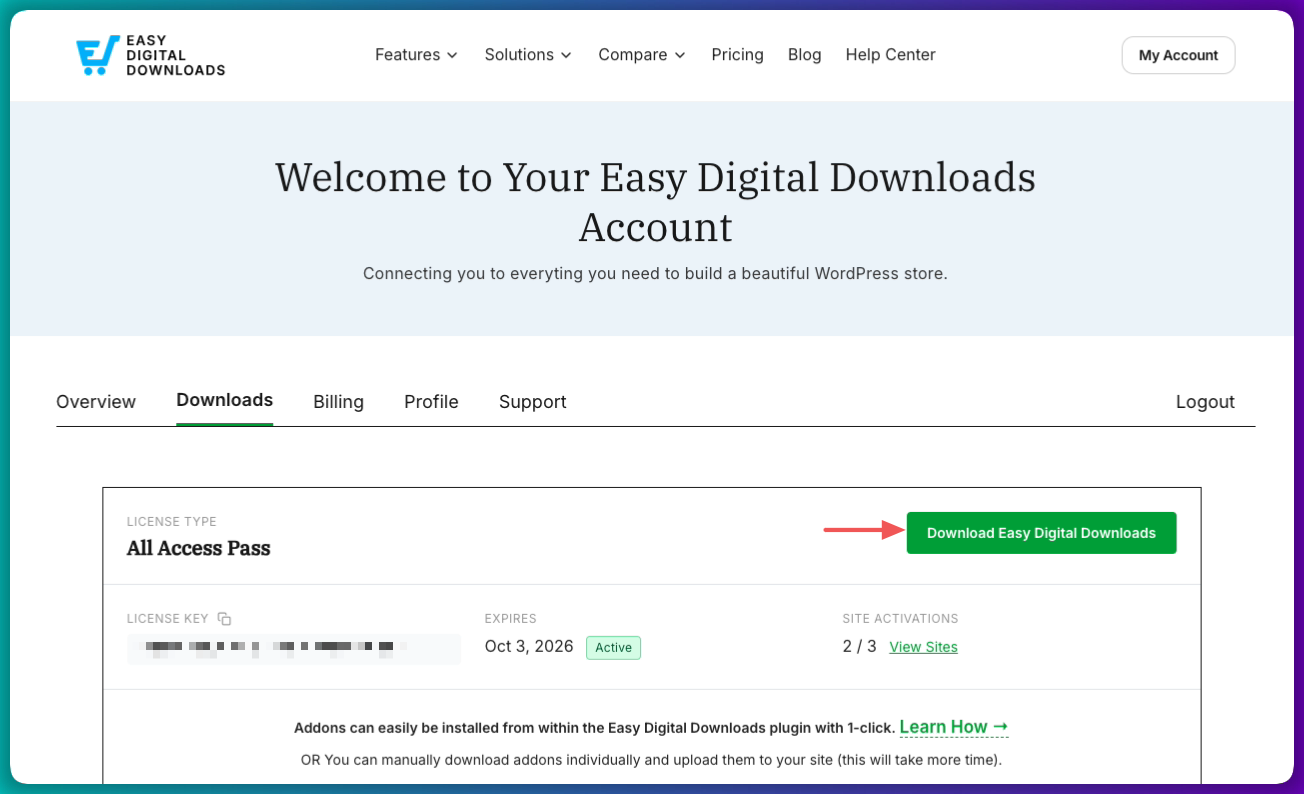
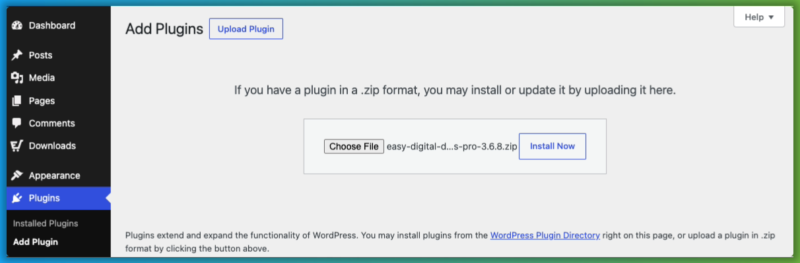
In your WordPress dashboard, go to Plugins » Add Plugin » Upload Plugin. Choose the .zip file you downloaded, click Install Now, then Activate.
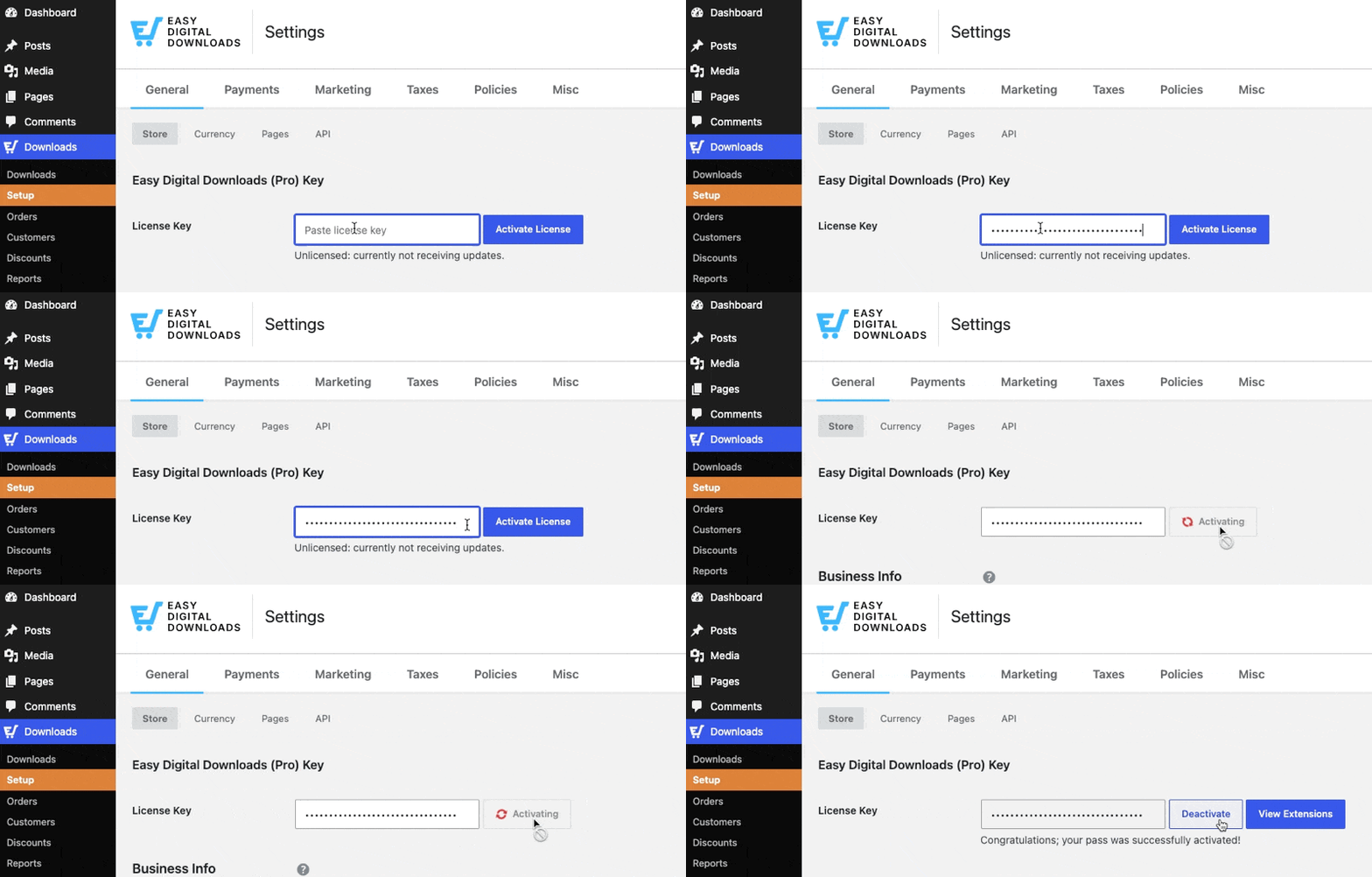
When prompted, paste in your license key from the account dashboard.
The Setup Wizard (Downloads » Setup » Get Started) walks you through the basics: connecting a payment gateway, configuring your store currency, and setting up your first download.
Once complete, both cloud storage features are available in your EDD account and ready to install.
Step 2: Choose Your Cloud Storage
EDD integrates natively with two cloud storage options. Choose one first. The connection steps are different for each, so pick before you move on.
| Amazon S3 | Dropbox File Store | |
|---|---|---|
| Best for | Very large files, flexible link expiry | Files under 2 GB, quick setup |
| File size limit | No practical limit | Up to 2 GB (64-bit server) |
| Download link expiry | Configurable (set in minutes) | Fixed at 4 hours (Dropbox limit) |
| Setup complexity | Moderate (requires AWS account and IAM setup) | Fast (OAuth in two steps) |
| Storage cost | AWS pay-as-you-go pricing | Included in your Dropbox plan |
| EDD plan required | Extended Pass or higher | Extended Pass or higher |
Pick Amazon S3 if you’re selling very large files (multi-gigabyte video courses, large software bundles, or asset packs) and you want full control over how long your download links stay active. Amazon S3 has no practical file size limit, and link expiry is fully configurable.
Pick Dropbox if your files are under 2 GB and you want the quickest possible setup. If your files are already saved in Dropbox, connecting takes just a few minutes.
Step 3: Connect Your Storage Account
Option A: Connect Amazon S3
In your WordPress dashboard, navigate to Downloads » Settings » Extensions » Amazon S3.
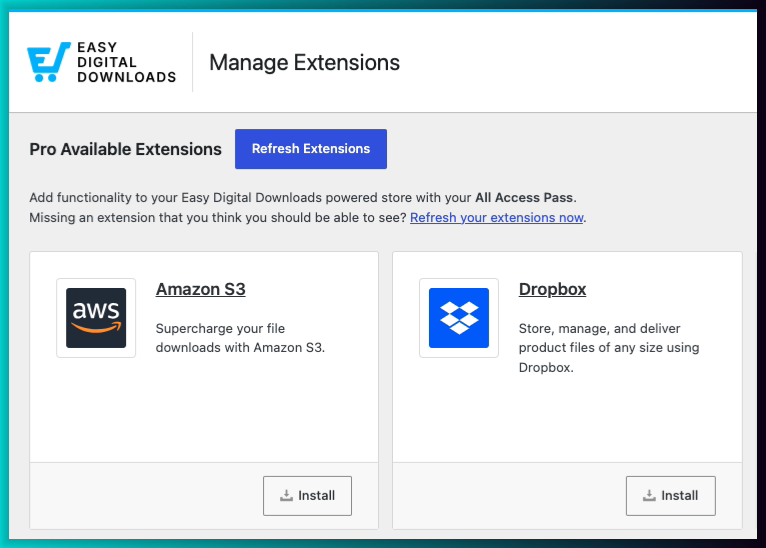
Once you select Install, the feature activates. Click on the gear icon to go to the settings.
You’ll need two credentials from AWS: an Access Key ID and a Secret Key. Both come from an IAM user with the AmazonS3FullAccess policy attached. Enter them into the corresponding fields in EDD, along with the name of your Default Bucket.
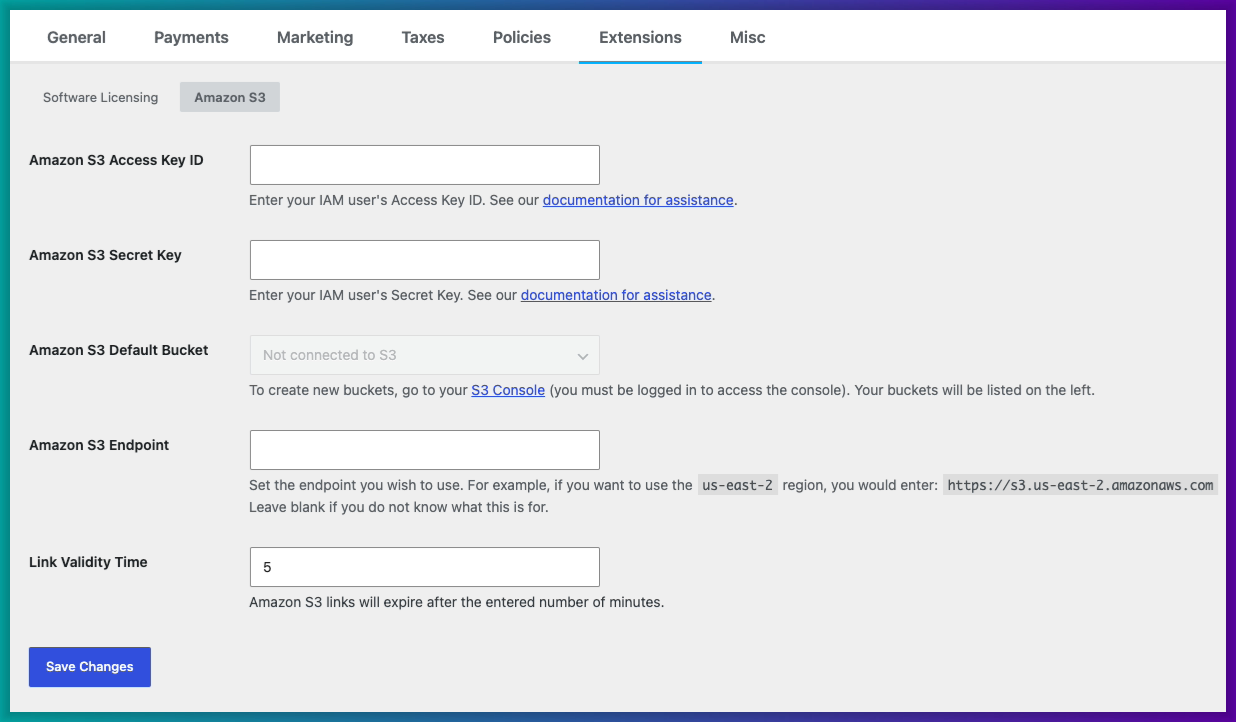
A few things to keep in mind before you save:
- Bucket names must be all lowercase with no spaces or special characters.
- Enable “Block all public access” on your S3 bucket in AWS. EDD generates temporary signed URLs, so public access isn’t needed.
- Amazon S3 files always use Redirect delivery regardless of your store’s default Download Method setting.
- Don’t paste a file URL directly from your S3 library into the File URL field. Use the Amazon S3 Library tab in the product editor instead. Pasting the URL directly causes an Access Denied error.
Once your credentials are saved, you’re ready to start attaching S3 files to your products.
⚙️ For the full setup guide including step-by-step IAM user creation and bucket configuration, see our Amazon S3 Setup doc.
Option B: Connect Dropbox
Go to Downloads » Settings » Extensions and install the Dropbox option. Then click the gear icon once it’s activated to go to the settings screen.
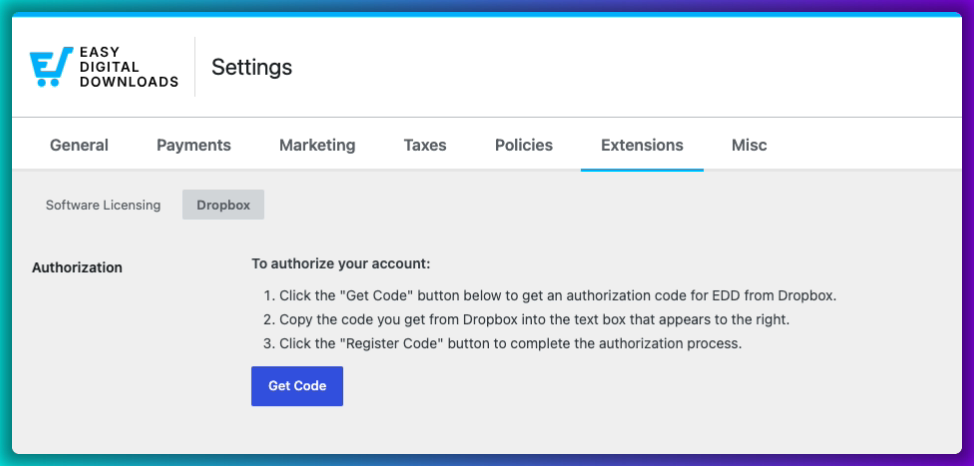
Click Get Code. A Dropbox authorization page opens in a new window.
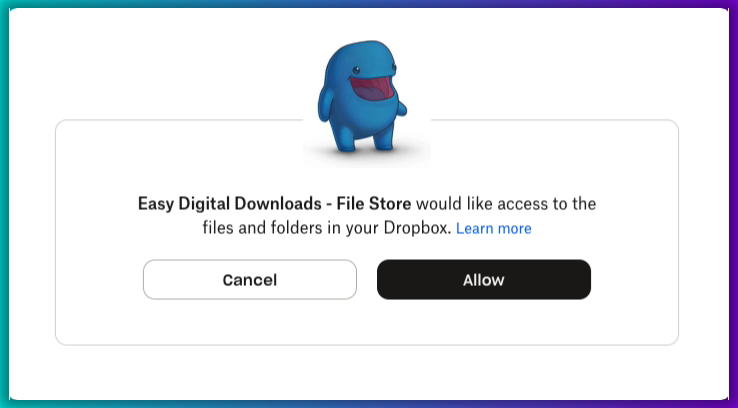
Click Allow to grant EDD access, copy the authorization code Dropbox gives you, paste it into the field in WordPress, and click Register Code.
⚠️ One limitation to know upfront: the temporary file URL that Dropbox generates expires after 4 hours. This is a Dropbox limitation and can’t be extended. It resets each time a customer uses their EDD receipt link. As long as the receipt link is still active, customers can re-click it to get a fresh download URL.
⚙️ For a full Dropbox connection walkthrough, see our Dropbox File Store Setup doc.
Step 4: Set Your Download Method
Navigate to Downloads » Settings » Misc » File Downloads.
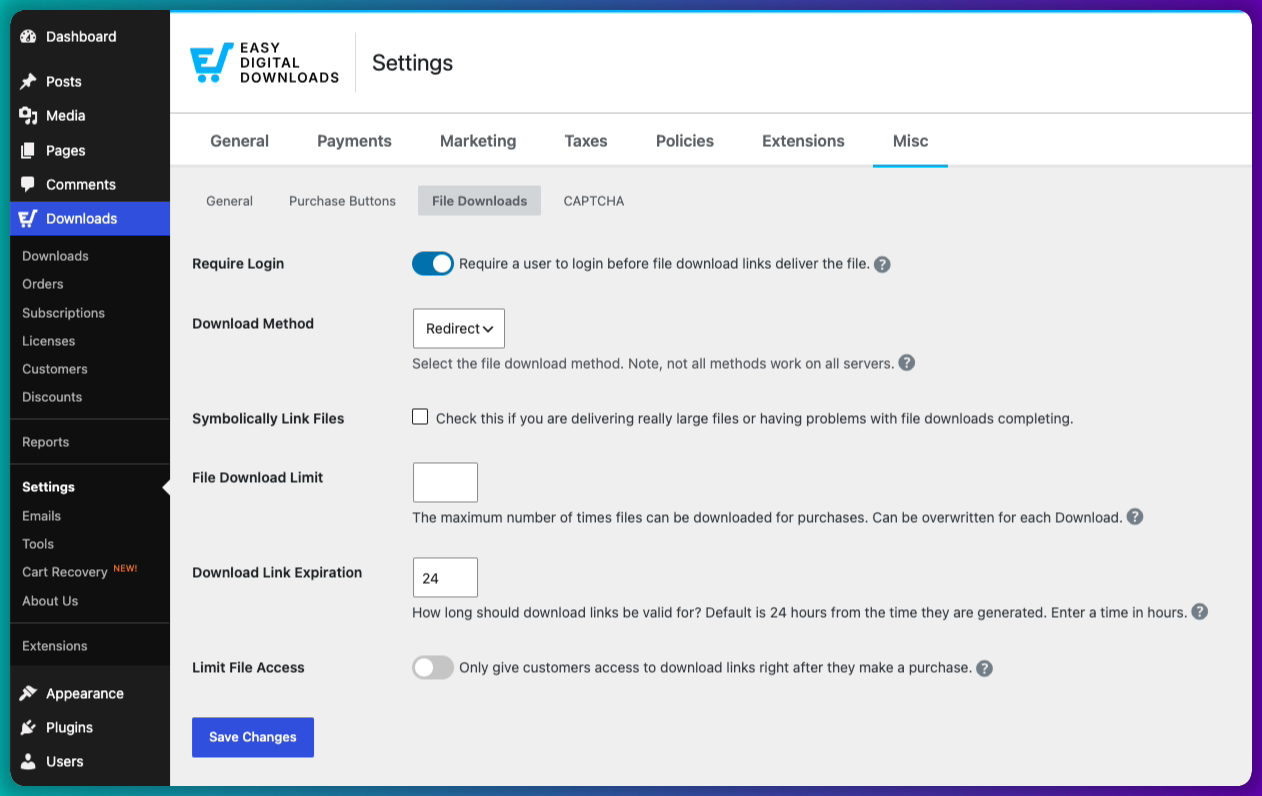
Set Download Method to Redirect.
With Redirect, EDD tells the customer’s browser where the file is located and the download happens directly from your cloud storage. Your server is completely out of the loop.
The default Forced method breaks files into chunks and proxies them through PHP. That works fine for small files, but it hits execution time limits for large ones and can cause failed downloads partway through. Don’t use it for large files hosted in S3 or Dropbox.
Download Link Expiration controls how long the purchase receipt download link stays active after checkout. The default is 24 hours. Raise it if your customers are likely to download over multiple sessions, or lower it if you want tighter access controls.
Remember to save your changes.
⚙️Learn more in our File Downloads settings doc.
Step 5: Upload Your File and Create Your Product
Go to Downloads » Add Download to create a new product.
Add your product title, description, and price. Then scroll to the Download Details » Files section and click the file field.
You’ll see different upload tabs depending on which storage option you connected.
If you connected Amazon S3:
- Upload to Amazon S3: select a file from your computer and EDD uploads it directly to your S3 bucket
- Amazon S3 Library: select a file already stored in your S3 bucket
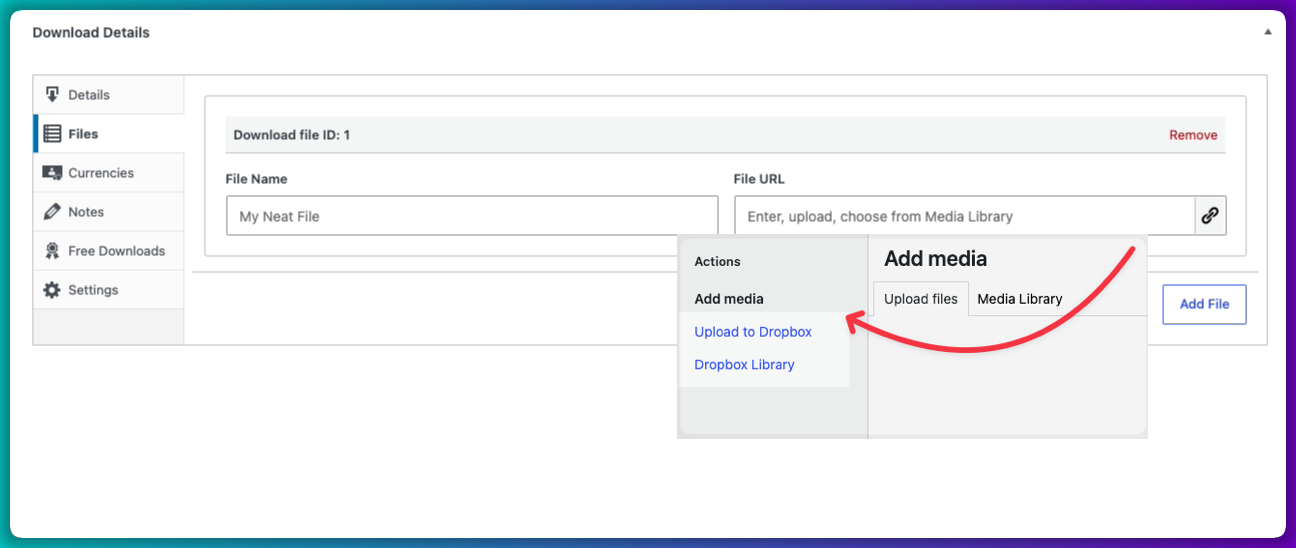
If you connected Dropbox:
- Upload to Dropbox: upload a file from your computer to your Dropbox account via WordPress
- Dropbox Library: select a file already saved in your Dropbox folder
⚠️ A quick note on Amazon S3 filenames: use lowercase letters and avoid special characters. S3 is strict about this. Special characters in filenames can cause access errors when customers try to download.
Set any per-product download limits you want, then click Publish.
After a customer checks out, they receive a purchase receipt with a secure, time-limited download link. The file downloads directly from your cloud storage. Your server doesn’t send a single byte.
For more, check out Creating Products in Easy Digital Downloads.
FAQs on Selling Large Files in WordPress
Let’s wrap up by answering some frequently asked questions users have about how to sell large files from their WordPress site.
What is the maximum file size I can sell in WordPress with EDD?
Easy Digital Downloads doesn’t set a maximum file size for selling. The limitation comes from your web server’s upload cap, typically between 32MB and 256MB depending on your host. With Amazon S3 or Dropbox File Store, that limitation no longer applies. Files live in the cloud, so there’s no server upload cap to hit. Note that Dropbox caps individual files at 2 GB on 64-bit servers. If your files are larger than that, Amazon S3 is the better choice.
Does Amazon S3 cost extra for WordPress stores?
Amazon S3 is a pay-as-you-go service through AWS. You pay for storage (around $0.023 per GB per month for standard storage) and data transfer costs. For most digital product stores, that works out to just a few dollars per month depending on file sizes and download volume. The EDD Amazon S3 feature itself is included with an Extended Pass or higher at no extra charge.
Can I use Dropbox to sell digital products on WordPress?
Yes. EDD’s Dropbox File Store feature connects your Dropbox account to your WordPress store via OAuth. Once connected, you can upload files to Dropbox through WordPress or select files already in your Dropbox account to attach to your products. Customers receive a secure, time-limited download link in their purchase receipt. One thing to know: the temporary download URL Dropbox generates expires after 4 hours, but customers can re-use their EDD receipt link to get a fresh one.
How do I protect large file downloads from unauthorized sharing?
EDD generates unique download links for each purchase. Links expire based on your Download Link Expiration setting (found under Downloads » Settings » Misc), and you can set a per-product download count limit to cap how many times a file can be accessed. With Redirect delivery, the actual file URL in S3 or Dropbox is never exposed to the customer. For more on access controls, see How to Restrict File Downloads in WordPress.
What download method should I use for large files in EDD?
Use Redirect. The Forced method makes EDD proxy the entire file through your server, which hits PHP memory and execution time limits for large files and can cause failed or incomplete downloads. With Redirect, the customer’s browser downloads directly from Amazon S3 or Dropbox. Your server doesn’t handle the file at all.
Start Selling Large Files on Your WordPress Site
Amazon S3 and Dropbox both connect directly to EDD, and once you set the Redirect method your server is completely out of the picture. Large files stop being a bottleneck and become a competitive edge.
You can sell a 10 GB course bundle, a massive sample pack, or a full software installer just as easily as a 5 MB PDF.
If you haven’t grabbed your Easy Digital Downloads pass yet, that’s where to start.
📣 P.S. Be sure to subscribe to our newsletter and follow us on Facebook, Twitter/X, or LinkedIn for more WordPress resources!