

Running a successful online store takes more than great products. It takes consistent marketing, prompt order fulfillment, timely customer communication, and accurate reporting. That’s a lot to manage manually.
eCommerce automation takes the repetitive work off your plate. Research shows that stores implementing automation reduce manual work by up to 40%, saving business owners an average of 15 to 25 hours per week. That’s time you can reinvest into product development, marketing, or simply stepping away from your desk.
In this guide, we’ll cover the main types of eCommerce automation, the best WordPress tools to set up, and which workflows are worth prioritizing first.
🔎 In this article, I’ll cover:
- What Is eCommerce Automation?
- Types of eCommerce Automation
- Best eCommerce WordPress Automation Tools
- FAQs about eCommerce Automation
- What is eCommerce automation?
- What tasks should I automate first?
- How can I get started with eCommerce automation?
- Can I use multiple eCommerce automation tools together?
- Is eCommerce automation worth it for small stores?
- Are there risks associated with over-automating?
- What is the best eCommerce automation tool for digital product sellers?
- Start Automating with Easy Digital Downloads
What Is eCommerce Automation?
Ecommerce automation is the practice of using software and technology to perform repetitive tasks and time-consuming processes in an online store automatically. This includes order processing, customer communication, marketing, and analytics.
Every automated workflow has two parts: a trigger and an action.
- The trigger is the event that kicks things off (like a completed purchase or an abandoned cart).
- The action is what happens next (like sending a confirmation email or notifying your CRM).
Once that workflow is live, it runs on its own.
Benefits of eCommerce Automation
- Time and cost savings
- Reduced human error
- Higher customer satisfaction
- Quicker order fulfillment
- Improved operational efficiency
- Consistent, timely marketing campaigns
- Detailed analytics and reporting for data-driven decisions
- Scalability and competitive advantage
The cumulative effect adds up fast. Stores that automate their core workflows typically see measurable improvements in both efficiency and revenue within the first few months.
Types of eCommerce Automation
There are different areas of eCommerce automation. Let’s explore some of the most popular.
eCommerce Marketing Automation
Marketing automation tools help you create, schedule, and deliver targeted campaigns without manual effort. This includes promoting limited-time offers, scheduling social media posts, and running keyword research to keep your content competitive.
The goal is simple: get the right message in front of the right customer at the right time, without you having to trigger it yourself.
Email Automation
Automated email is one of the highest-ROI channels in eCommerce. Instead of sending individual messages, you build sequences triggered by customer behavior. A new subscriber gets a welcome series. A buyer gets an order confirmation, then a review request a week later. A lapsed customer gets a win-back offer at 90 days.
The trigger-and-action structure is what makes this work: each email fires based on a specific customer event, not a manual send. Once the sequence is built, it runs automatically for every customer who hits that trigger.
Abandoned Cart Automation
Cart abandonment is one of the most common revenue leaks for online stores. A customer adds a product, gets distracted, and never comes back.
Automated recovery emails sent 1 to 3 hours after abandonment can recover up to 30% of that lost revenue.
A well-built recovery sequence includes three touchpoints: an initial reminder, a follow-up with a soft incentive (like a discount code), and a final urgency message.
For digital product sellers, abandoned cart recovery is especially valuable. A customer who added your plugin or course to their cart was already close to buying. A timely, personalized reminder often closes the sale.
You can automate and personalize recovery emails with conditional tags.
AI-Powered Automation
AI has changed what’s possible with eCommerce automation. Modern AI tools can personalize product recommendations in real time, respond to customer questions without human input, and predict which customers are most likely to churn before they do.
The key areas where AI automation is making an impact right now:
- Product recommendations based on browsing and purchase history
- AI chatbots that handle support queries 24/7
- Personalized email content and subject line optimization
- Predictive customer segmentation to identify high-value buyers
These aren’t enterprise-only features. Several of the tools in this guide include AI capabilities on mid-tier plans, and some are available on free plans. For instance, EDD offers Smart Cart Recommendations to all Pro users.
Customer Support Automation
When it comes to eCommerce, customer satisfaction is of utmost importance. Poor customer support, such as slow response times, can hurt your retention rates and overall success.
CRM software, helpdesk systems, and AI-powered chatbots reduce the volume of support tickets your team handles manually.
Chatbots answer common questions instantly. Ticketing systems route complex issues to the right team member. Knowledge bases let customers find answers on their own, any time of day.
Automated Reporting and Analytics
Automated reporting collects, analyzes, and shares performance data without manual effort.
Instead of pulling numbers from multiple platforms, you set up dashboards that update in real time and schedule reports to land in your inbox when you need them.
It saves time and money by streamlining the process and providing actionable insights to make informed decisions.
Secure Payment Processing
Payment automation verifies payment details, detects fraud, authorizes and captures funds, and manages subscription renewals and refunds.
For most stores, this happens entirely in the background once a payment processor is configured.
Digital Product Delivery Automation
If you sell digital products, automation handles the entire post-purchase experience without any manual steps. This is one area where tools built specifically for digital goods outperform general-purpose eCommerce platforms.
Digital product delivery automation covers:
- Delivering download files immediately after purchase
- Generating and sending license keys for software products
- Sending notifications when a new file version is available
- Expiring download links automatically after a set time
- Triggering subscription renewal reminders before a license lapses
Best eCommerce WordPress Automation Tools
There’s no single tool that does everything. The best automation stack for your store depends on what you sell, how you market, and where your biggest time drains are.
Here are 11 of the best options for WordPress store owners.
| Automation Plugin | Free | Pricing | Used For |
|---|---|---|---|
| Easy Digital Downloads | ✅ | $199-$999/yr | Selling digital products |
| Uncanny Automator | ✅ | $149/yr | WordPress workflow automation |
| OptinMonster | ✅ | $7/mo | Lead generation |
| WPForms | ✅ | $49.50–$299.50/yr | WordPress forms |
| HubSpot | ✅ | Varies by product/plan | CRM and marketing automation |
| MonsterInsights | ✅ | $99.50–$399.50/yr | Website analytics |
| PushEngage | ✅ | $19 – $99/mo | Push notification campaigns |
| Smash Balloon | ✅ | $49-$299/yr | Social media feeds |
| AIOSEO | ✅ | $49.60–$299.60/yr | SEO automation |
| Blog2Social | ✅ | $8/mo | Social media scheduling |
| HelpJet | ✅ | $29/mo | AI customer support |
1. Easy Digital Downloads
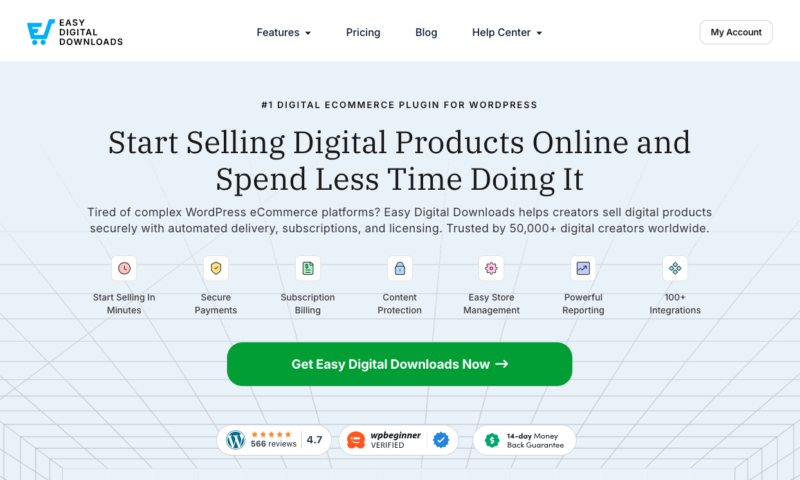
Easy Digital Downloads (EDD) is the most complete eCommerce solution for selling digital products directly from WordPress. It handles the full automation stack for digital sellers: payment processing, file delivery, license key generation, abandoned cart recovery, and subscription management.
The AI-powered Smart Cart Recommendations feature (launched February 2026) surfaces personalized upsell and cross-sell suggestions at checkout based on what’s in a customer’s cart.
It also offers Abandoned Cart Recovery, which you can enable with a simple switch. This automates abandoned cart emails to recapture lost sales.
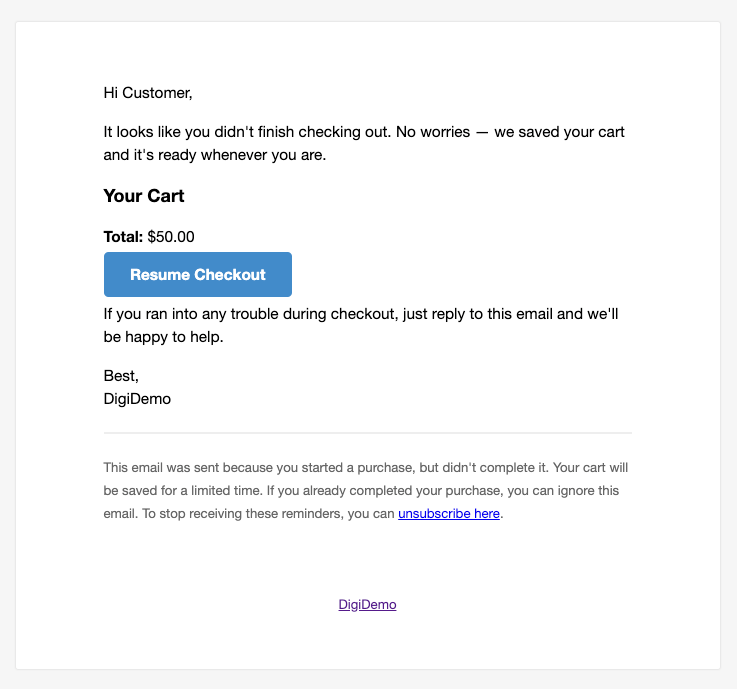
You can customize which products appear using conditional tags. Display rules that let you control exactly when and for whom a recommendation shows up, without writing any code.
EDD Pro added conditional email tags in March 2026, letting you personalize email automation based on customer behavior, purchase history, and subscription status.
- A renewal reminder can show different content to customers who are on a monthly plan versus an annual one.
- A follow-up email can include or exclude sections depending on what a customer has already bought.
The result is more relevant messaging with no additional manual effort.
🔑 Key Features
- Automated file delivery after purchase
- Built-in abandoned cart recovery emails (Pro)
- Conditional email tags for personalized messaging (Pro)
- Recurring payment processing and renewal reminders
- License key generation and delivery (Pro)
- Automated customer registration and Magic Login Links at checkout
- AI-powered Smart Cart Recommendations with conditional tags (Pro)
- Discount and coupon code management
- Sales reporting and performance analytics
Pricing: There is a free Lite version of Easy Digital Downloads. However, upgrading to EDD Pro offers the most value as it includes access to premium add-ons and features. Plans start at $99 per year.
2. Uncanny Automator

Uncanny Automator is the most powerful workflow automation plugin for WordPress. It connects your WordPress plugins and external apps to create automated workflows without any code. Think of it as Zapier built specifically for the WordPress ecosystem.
When a customer purchases a product in Easy Digital Downloads, Uncanny Automator can automatically tag them in your CRM, enroll them in an email sequence, send a Slack notification, and log a row to Google Sheets. All from a single trigger, all without touching any code.
🔑 Key Features
- Connect 190+ WordPress plugins and apps
- Visual trigger/action workflow builder (no code required)
- EDD integration for purchase-triggered automations
- Multi-step workflow support
- Webhook support for custom integrations
Pricing: Free version available. Pro plans start at $149/year.
3. OptinMonster
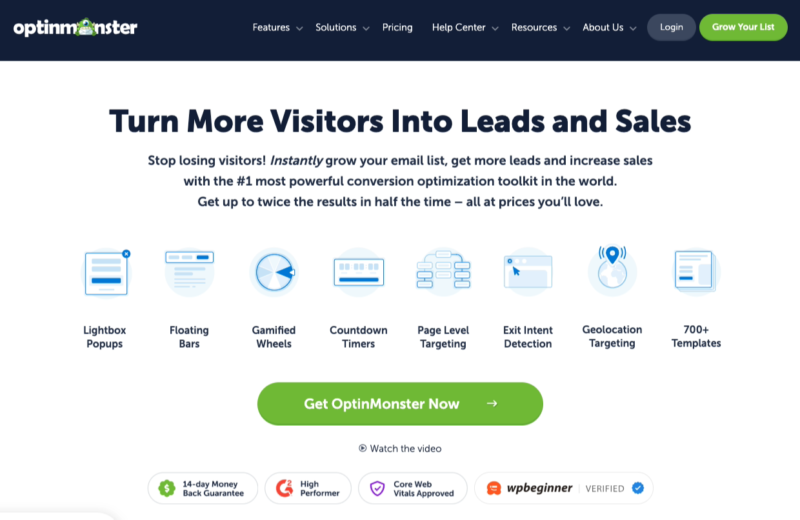
OptinMonster is the leading WordPress lead generation plugin for lead generation and conversion optimization.
It automates the process of turning website visitors into email subscribers and customers using behavior-based triggers like exit intent, time on page, and scroll depth.
OptinMonster helps businesses capture leads, reduce cart abandonment, and boost conversions.
🔑 Key Features
- Exit-Intent Technology that reduces abandonment
- A/B testing to optimize forms for higher conversion rates
- Targeted campaigns with behavior triggers & display conditions
- Integration with popular email marketing, eCommerce & CRM platforms
- Geo-location targeting for specific promotions or messaging
- Detailed analytics & reporting
Pricing: OptinMonster offers a range of pricing plans, starting at $7/month (billed annually). It also has a 14-day money-back guarantee.
4. WPForms
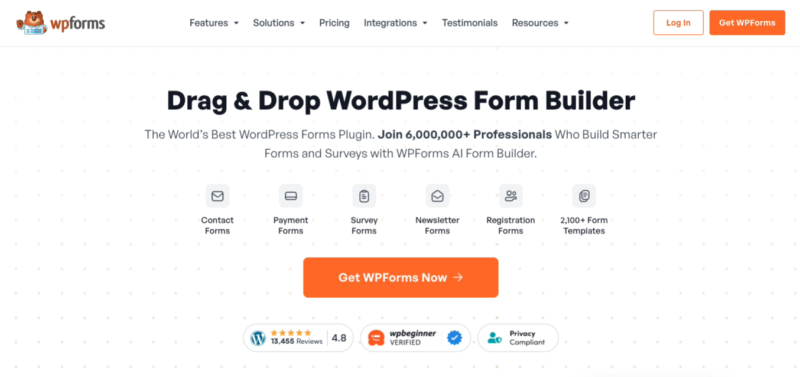
WPForms is the most user-friendly WordPress form builder, and it comes with built-in automation capabilities.
It handles form-based workflows: automatically adding form submitters to your email list, triggering notification sequences, and routing leads to the right person on your team.
In an eCommerce context, WPForms can be used to create order forms, capture customer information, and connect with third-party tools to automate email responses and marketing campaigns.
🔑 Key Features
- Drag-and-drop builder with 1,000+ templates
- Email sequence triggers on form submission
- Automatic email list enrollment
- Payment fields, file uploads, and conditional logic
- Integration with HubSpot, Mailchimp, Constant Contact, and more
Pricing: There is a free, Lite version of WPForms. Premium plans start at $49.50 per year.
5. HubSpot
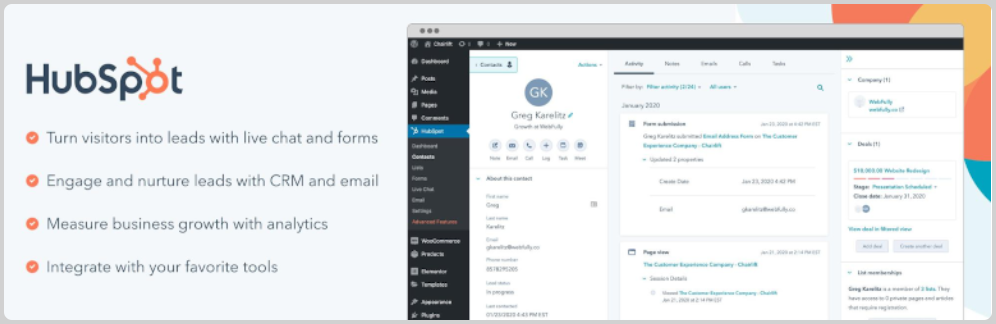
HubSpot is the most comprehensive free CRM with built-in marketing automation. It covers contact management, email marketing, live chat, and sales workflows in a single platform.
While technically a suite of tools and software, HubSpot does have a free WordPress plugin that can help with email marketing, CRM, lead management, and other aspects of eCommerce automation.
The free plan is genuinely useful. But paid plans unlock advanced segmentation and multi-step automation sequences.
🔑 Key Features
- Automated email marketing sequences
- Contact management and customer segmentation
- Helpdesk, ticketing, and knowledge base
- Workflow automation and lead scoring
- Detailed reporting and analytics
Pricing: HubSpot offers a free CRM and Wordpress plugin with limited features. Premium pricing varies based on the features and services you need.
6. MonsterInsights

MonsterInsights is the leading Google Analytics plugin for WordPress. It automates data collection by pulling Google Analytics directly into your WordPress dashboard.
You see eCommerce tracking, conversion data, and page-level analytics without ever logging into a separate platform.
MonsterInsights empowers businesses to make data-driven decisions and optimize their eCommerce strategies. It’s also convenient and easy to use.
🔑 Key Features
- Automated Google Analytics integration
- Enhanced eCommerce tracking
- Real-time stats dashboard
- Conversion tracking for marketing campaigns
- Page-level analytics for product pages
Pricing: Free version is available. Premium plans start at $99.50 per year.
7. PushEngage
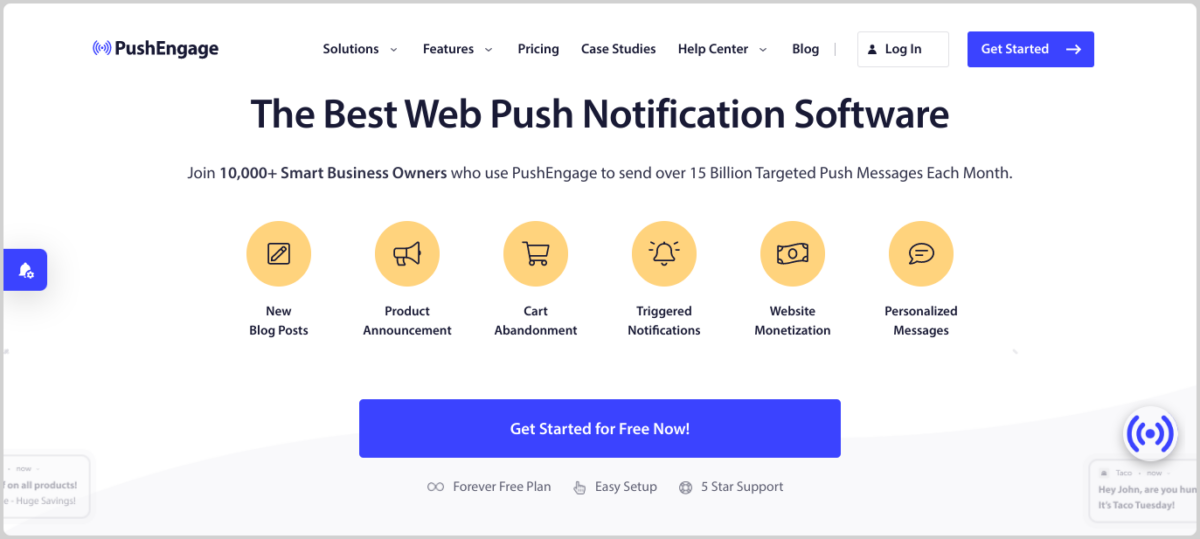
PushEngage is the best push notification tool for automated, real-time customer engagement. It sends push notifications to subscribers across browsers and devices.
Use it for abandoned cart recovery, new product announcements, or drip campaigns that run on autopilot.ement, site traffic, and conversions as well as reduce shopping cart abandonment.
You can create, customize, and schedule notifications for desktop and mobile devices. Once you integrate the PushEngage plugin with your eCommerce store, you can do all of this directly from your WordPress site.
Users can opt-in to receive these notifications based on the configured triggers and schedule.
🔑 Key Features
- Automated cart abandonment recovery via push notifications
- Drip notification campaigns
- Personalization and audience segmentation
- Customizable opt-in prompts and CTAs
- Performance analytics
Pricing: PushEngage offers a free plan with limited features and a limited number of subscribers. Premium plans start at $8 per month when billed annually or $19 per month.
8. Smash Balloon

Smash Balloon is the easiest way to automatically display social media feeds on your WordPress site. It pulls live content from Instagram, Facebook, YouTube, X (formerly Twitter), and TikTok into customizable feeds. Your social proof stays current without any manual effort.
With over 1.4 million active users, Smash Balloon is the most popular social media feed plugin for WordPress. It’s a reliable tool with extensive customization options and mobile-friendly feeds that can adapt to any screen size.
🔑 Key Features
- Supports Facebook, Instagram, X, TikTok, and YouTube
- Automatic feed updates
- Pre-designed templates
- Display post counts, likes, and comments
- Content moderation tools
Pricing: Free versions available for individual platforms. Premium licenses range from $49 to $299/year.
9. AIOSEO
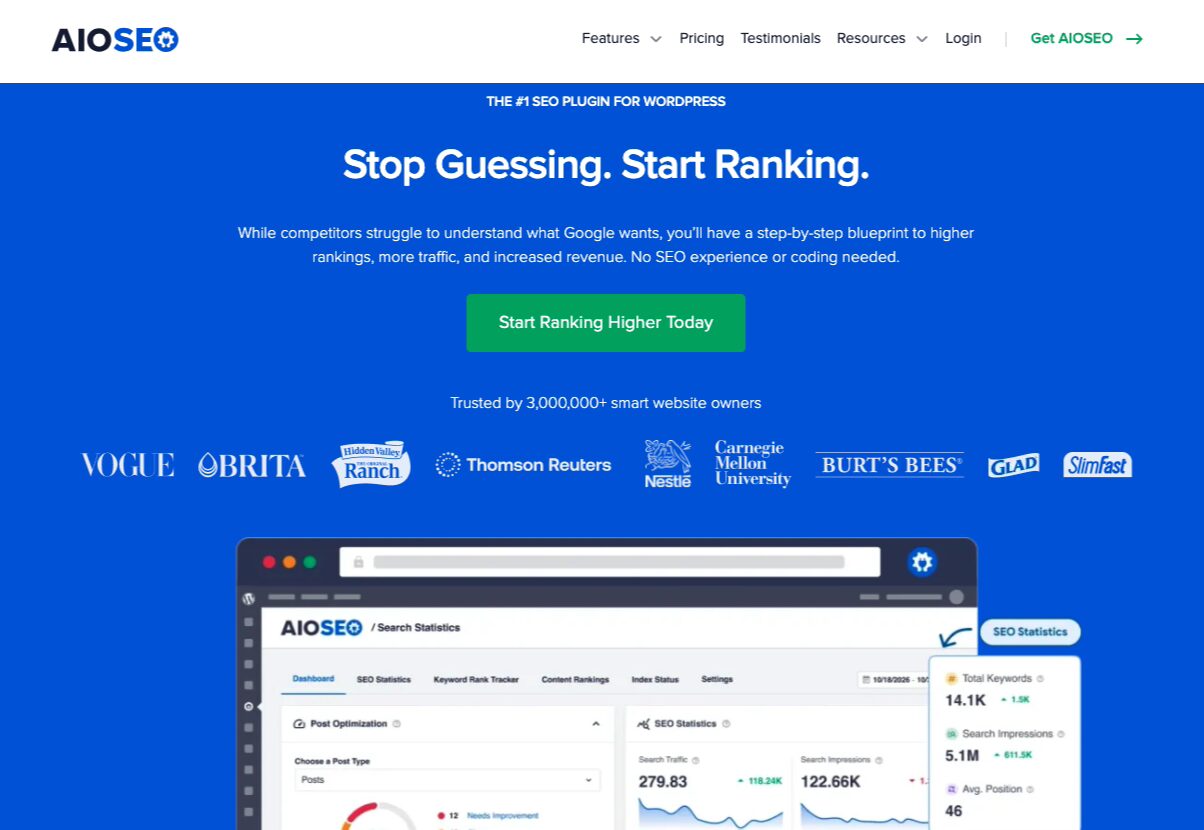
All in One SEO (AIOSEO) is the most complete WordPress SEO plugin with built-in automation. It handles the technical SEO work that would otherwise take hours each week: sitemap generation, schema markup, metadata management, and search performance analysis.
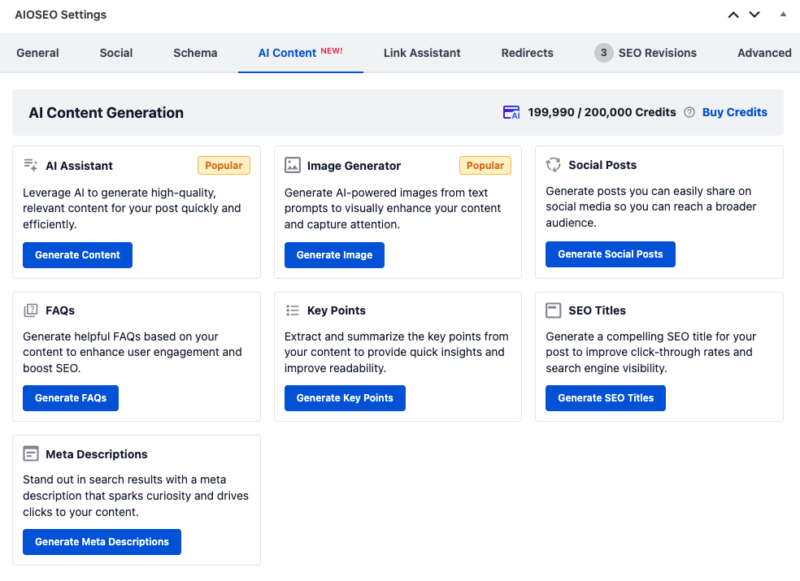
It’s packed with optimization and AI content generation features to help improve your search visibility.
The Search Statistics panel pulls Google Search Console data directly into your WordPress dashboard, so you can track impressions, clicks, and keyword rankings without switching platforms.
🔑 Key Features
- AI Content Generation and Optimization
- Automated XML sitemaps and schema markup
- Metadata and image SEO management
- Easy Digital Downloads and WooCommerce integration
- Local SEO and social media integration
- Automated performance analysis
Pricing: A free version is available. The premium version starts at $49.50 per year for a single site.
10. Blog2Social

Blog2Social simplifies sharing and promoting your WordPress content across multiple social media platforms.
Set your posting schedule once, and your content goes out automatically across Facebook, LinkedIn, Instagram, Pinterest, and more.
This convenience can significantly aid in automating the marketing of eCommerce products, promotions, and blog posts. Not only can this save you time, but it also helps to ensure a consistent online presence.
🔑 Key Features
- Auto-posting to 17+ social networks
- Visual content calendar
- Post customization per platform
- Hashtag suggestions
- Analytics (likes, shares, comments, CTR)
Pricing: There is a free version of the Blog2Social plugin available in the WordPress Plugin Directory that includes basic features and limited social media accounts. Premium plans start at $8 per month for a single site.
11. HelpJet

HelpJet is an AI-powered chatbot and helpdesk built for WordPress stores. It puts customer support on autopilot by answering common questions instantly using your knowledge base, routing complex issues to your team, and integrating with Easy Digital Downloads to pull order data directly.
Instead of customers waiting for a reply, HelpJet gives them accurate answers in seconds. Your support team spends less time on repetitive tickets and more time on issues that actually need a human touch.
🔑 Key Features
- AI chatbot trained on your knowledge base
- Helpdesk and ticketing system
- Easy Digital Downloads integration for order lookups
- Multilingual support
- Visitor tracking and mobile app
Pricing: Free plan available (1 bot, 100 conversations/month). Pro plans start at $29/month.
FAQs about eCommerce Automation
What is eCommerce automation?
eCommerce automation is the process of using software to handle repetitive store tasks automatically. Each workflow has a trigger (a customer event, like a purchase or an abandoned cart) and an action that follows (like sending an email or updating a CRM record). Once the workflow is live, it runs on its own for every customer who hits that trigger.
What tasks should I automate first?
Start with abandoned cart recovery. It’s the highest-ROI automation for most stores and takes less than an hour to configure. After that, set up your post-purchase sequence (order confirmation, receipt, and a follow-up review request), then build your welcome email series for new subscribers. Get those three workflows live before adding anything else.
How can I get started with eCommerce automation?
Start by identifying your most repetitive tasks. Order confirmations, download delivery, and cart abandonment emails are good first targets. Choose a tool that handles those workflows (Easy Digital Downloads covers all three for digital product sellers), and build your first automation before adding more. Expand from there as your store grows.
Can I use multiple eCommerce automation tools together?
Yes. Most automation tools are built to integrate with each other. Easy Digital Downloads connects natively to Mailchimp, ActiveCampaign, HubSpot, and other platforms. Uncanny Automator extends this further, linking EDD to 190+ apps and plugins without any code. The result is a connected automation stack where one customer action can trigger workflows across multiple tools.
Is eCommerce automation worth it for small stores?
Yes, especially for tasks that repeat every day. Even a small store handling 5 to 10 orders per week can save hours each month by automating order confirmations, file delivery, and basic customer communication. The time savings compound as your order volume grows, and many of the best automation tools offer free plans to get started.
Are there risks associated with over-automating?
Yes. Automating too much can strip the personal touch out of your customer relationships. If every interaction feels scripted, customers notice. Automation works best for rules-based, repetitive tasks: confirmations, delivery, follow-ups, and reporting. For complex issues, disputes, or situations that require judgment, keep a human in the loop.
What is the best eCommerce automation tool for digital product sellers?
Easy Digital Downloads is purpose-built for digital product sellers and covers more of the automation stack than any other WordPress plugin in this category. It handles file delivery, license key management, subscription renewals, abandoned cart recovery, and AI-powered product recommendations out of the box — without needing multiple third-party plugins to piece it together.
Start Automating with Easy Digital Downloads
Running your store shouldn’t mean spending hours on tasks that software can handle for you. Whether you start with abandoned cart recovery, automated email sequences, or AI-powered product recommendations, each workflow you add buys back time you can put toward growing your business.
Easy Digital Downloads gives digital product sellers the most complete automation stack on WordPress. From instant file delivery to AI-powered checkout recommendations, it handles the full customer journey automatically.
Ready to get started?
📣 P.S. Be sure to subscribe to our newsletter and follow us on Facebook, Twitter/X, or LinkedIn for more WordPress resources!